




The Science of the Perfect Puff
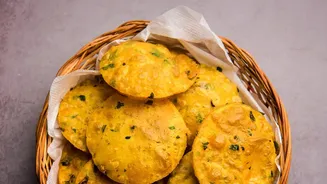
The glorious puff of a poori is a beautiful example of kitchen physics. It all begins with the dough, which contains moisture. When you slide the rolled poori into hot oil, the surface cooks and hardens almost instantly, creating a seal. Simultaneously,
the intense heat turns the trapped moisture inside the dough into steam. This steam needs to escape, but with the surface sealed, it has nowhere to go. It exerts pressure from the inside, pushing the top and bottom layers of the poori apart and causing it to inflate like a balloon. For this to happen successfully, a few things need to be just right: a stiff dough, the correct oil temperature, and, crucially, a uniform thickness across the poori.
Why a Round Shape Is Optimal
This is where the headline's claim comes into play. A perfectly round poori is, by its nature, more likely to have a uniform thickness from the centre to the edges. When you roll a circle, the pressure from the rolling pin is distributed more evenly, preventing spots that are too thin or too thick. Why does this matter? If a poori has a thin spot, the steam will find this weak point and burst through it instead of lifting the entire surface. If it has a thick spot, the heat won't penetrate quickly enough to generate sufficient steam pressure before the poori overcooks. An irregular shape, with its unpredictable corners and varying thickness, has multiple potential failure points. A circle, on the other hand, provides the most structurally sound and consistent surface for the steam to do its work, resulting in that satisfying, even puff.
Mastering the Uniform Roll
Achieving a perfect circle can be a challenge even for experienced cooks. The key is to start with a smooth, crack-free ball of dough. Instead of dusting your rolling surface with dry flour, which can burn in the hot oil and spoil the taste, use a few drops of oil on the rolling pin and surface. This prevents sticking and helps you roll smoothly. Begin by flattening the ball in the centre and then apply even pressure as you roll outwards, rotating the poori as you go. Focus on rolling from the edges rather than just the centre to avoid a common mistake where the middle becomes thin while the edges remain thick. If you're a beginner, don't worry about getting a map of India. You can use a round, sharp-edged bowl or a cookie cutter to cut perfect circles from a larger rolled sheet.
Beyond the Shape: Other Puffing Essentials
While a round shape is a huge advantage, other factors are just as important for a guaranteed puff. The dough must be stiff—firmer than a chapati dough—as a soft dough will absorb too much oil. The oil temperature is non-negotiable. It must be very hot. Test it by dropping in a tiny piece of dough; if it sizzles and rises to the surface immediately, the oil is ready. When frying, gently slide the poori into the oil. As it starts to rise, use the back of a slotted spoon to press down gently. This action helps trap the steam more rapidly, encouraging a faster and more dramatic puff. Once it puffs, flip it over and cook for just a few seconds on the other side until golden brown.