



A Cosmic Slowdown
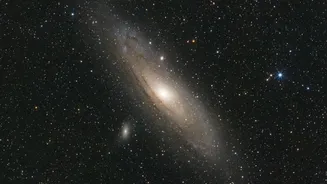
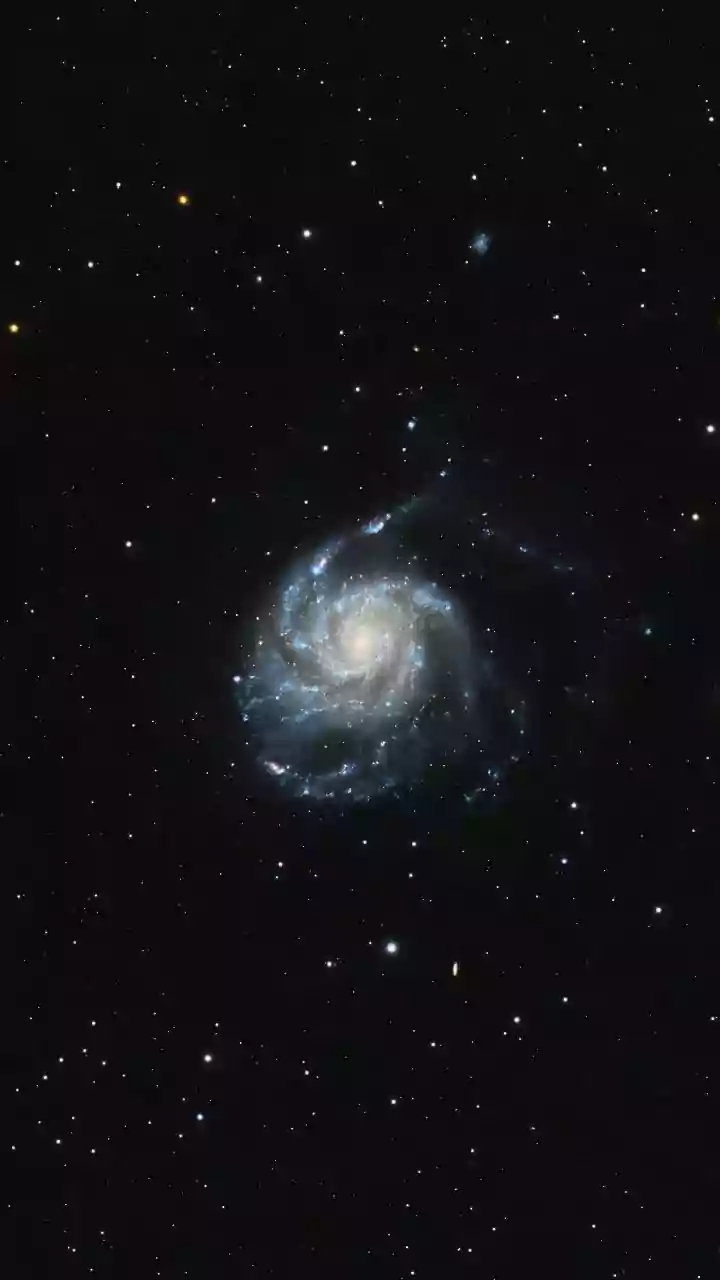
Imagine a bustling city that gradually grows quiet. According to a new study, that's what has been happening in the Andromeda galaxy for the last 500 million years. Astronomers using a treasure trove of Hubble data found that our neighbouring galaxy's
star-making engine is winding down. This slowdown follows a major burst of activity about 2 billion years ago, likely caused by a collision with another, smaller galaxy. Since then, the pace has been steadily decreasing. About 500 million years ago, Andromeda was creating stars at a rate of roughly one solar mass per year, similar to our own Milky Way's current output. But by 40 million years ago, that rate had been cut in half. Today, it has plummeted to just one-fifth of a solar mass annually, a significant drop for a galaxy of its size. This detailed history suggests Andromeda is not simply running out of fuel, but rather entering a more settled, quieter phase of its life.
Reading a Galaxy's Fossil Record
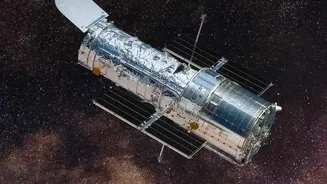
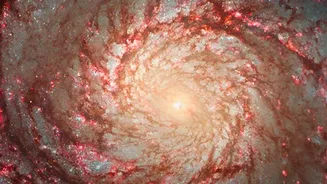
So, how can scientists read the history of a galaxy 2.5 million light-years away? The key is treating its stars like a fossil record. The Hubble Space Telescope is uniquely powerful enough to resolve individual stars within Andromeda, a feat impossible for more distant galaxies. By mapping the locations of some 200 million stars, researchers could piece together a timeline. The method relies on a simple principle: massive, young stars burn hot and appear blue, but they have short lives. Older, less massive stars are redder and live much longer. By analyzing the colour of different regions, scientists can determine when they last formed stars. This massive undertaking, combining data from two huge surveys known as PHAT and PHAST, allowed astronomers to create the most detailed map ever of Andromeda's recent star-birth history, square by 300-light-year square.
A Tale of Two Galaxies
This research isn't just about understanding Andromeda; it's about understanding ourselves. Because we are located inside the Milky Way, we can't get a clear, outside-in view of our own galaxy's structure and history. Andromeda serves as our perfect cosmic laboratory, a proxy for spiral galaxies like our own. By observing its evolution in such detail, we gain invaluable insights into the processes that shape galaxies throughout the universe. The study highlights the different paths galaxies can take. While Andromeda is slowing down, the Milky Way continues to churn out stars at a more consistent rate. Studying why these two similar-sized neighbours are on different trajectories helps astronomers refine their models of galactic life cycles, from fiery youth to quiet old age.
The Case of the Pesky Neighbor
The study also uncovered a tantalizing clue in a cosmic mystery involving Andromeda's small, compact satellite galaxy, M32. Astronomers have long wondered if M32's gravity is influencing star formation in Andromeda's disk. The new data shows that the region of Andromeda closest to M32 began to show a significant drop in star formation about 60 million years ago. While this makes M32 the 'most likely suspect' for causing this localized slowdown, the case isn't closed. The timing doesn't perfectly align with leading theories about when M32 might have passed through Andromeda's disk. Scientists can't be certain because they don't know the precise three-dimensional distance between the two, leaving it an open question for future telescopes to investigate.