


A New Window On Our Star
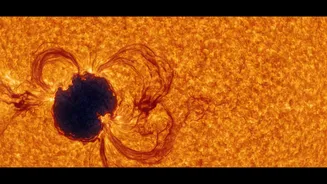
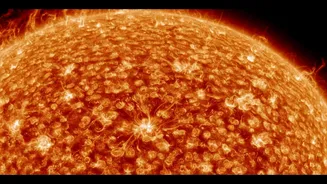
Scientists have released the most detailed images of the Sun's surface ever taken, captured by the National Science Foundation's Daniel K. Inouye Solar Telescope in Hawaii. These unprecedented pictures reveal features as small as 20 kilometers across,
a scale so fine that they have gone completely undetected until now. The images show a turbulent, boiling pattern of plasma covering the entire sun, with cell-like structures, each about the size of Texas, that are signatures of the violent motions transporting heat from the inside of the star to its surface. This technological leap provides a new, high-resolution window into the complex physics governing our home star.
Discovering Tiny Solar Whirlpools
Hiding in plain sight for 150 years, thousands of tiny whirlpools have been discovered twisting across the Sun's surface. These small vortices are signatures of a phenomenon called Kelvin-Helmholtz instability (KHI), which was first described in the 19th century but never before confirmed on the Sun's surface. KHI occurs when two fluids, in this case, streams of solar plasma, slide past each other at different speeds, causing the friction between them to roll up into spiraling patterns. The new time-lapse footage from the Inouye telescope shows these tiny vortices, some just tens of miles across, clustering along the edges of magnetic regions.
Solving a Half-Century-Old Mystery
These newly discovered whirlpools could be the key to solving one of the biggest mysteries in solar physics: the coronal heating problem. For decades, scientists have been puzzled as to why the Sun's outer atmosphere, the corona, is millions of degrees hotter than its surface, which is a comparatively cool 6,000 degrees Celsius. It defies simple logic, like a fire getting hotter the further you move away from it. The new observations suggest that the constant swirling and twisting of these tiny vortices could be the mechanism that transfers energy from the surface, braiding magnetic field lines and cascading energy upwards to superheat the corona.
Why It Matters for Us on Earth
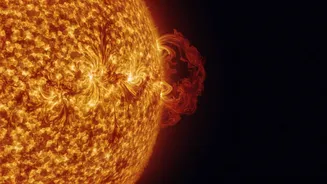
Understanding the Sun's behavior isn't just an academic exercise; it has profound practical implications. The same magnetic energy that heats the corona can also power solar flares and coronal mass ejections (CMEs). These powerful eruptions send streams of charged particles hurtling through space. If aimed at Earth, this space weather can disrupt our modern, technology-dependent society. Severe solar storms can damage satellites, interfere with GPS navigation and radio communications, and even cause widespread failures in power grids. By understanding the fundamental processes that drive these events—processes now visible in these new images—scientists hope to improve their ability to forecast space weather and protect our critical infrastructure.