



A Sweet Discovery in the Stars
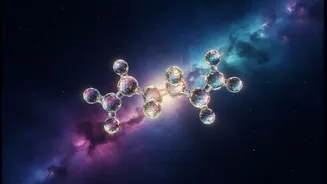
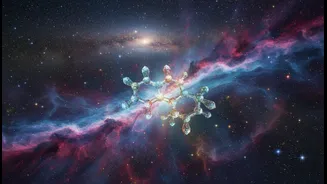
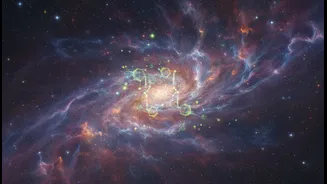
Astronomers have detected a complex sugar molecule called erythrulose floating in a vast cloud of gas and dust near the center of our Milky Way galaxy. This marks the first time a true sugar has been found in the interstellar medium—the raw material from
which stars and planets are born. While you might find erythrulose in raspberries or even self-tanning products on Earth, its presence some 26,000 light-years away has profound implications for understanding how life might begin. Sugars are fundamental to life as we know it; they form the backbone of RNA and DNA and provide energy for cells. Finding them in the primordial soup of a stellar nursery suggests these key ingredients are available right from the start.
Rewriting the Cosmic Cookbook
This finding challenges the long-held belief that complex molecules form sequentially, with smaller molecules gradually adding one carbon atom at a time to build larger structures. The discovery of erythrulose, a four-carbon sugar, in greater abundance than its simpler three-carbon cousins turns this idea on its head. Scientists now believe that in the frigid temperatures of space, around -250°C, simpler compounds on the surface of icy dust grains can combine to form more complex sugars directly. Specifically, researchers suggest erythrulose may form from the combination of two-carbon molecules. This means the building blocks of life don't need a long, slow cooking process; they can be synthesized relatively quickly in the earliest, coldest stages of star formation.
An Earlier Start for Life's Ingredients
The previous assumption was that for life to begin, a planet would need to form first and then either synthesize these complex molecules on its surface or have them delivered later by comets and asteroids. While we have found sugars on meteorites before, this new discovery pushes the timeline back significantly. It shows that complex sugars exist in the interstellar cloud before planets and asteroids even form. This means that as new solar systems come into being, they could be seeded with these essential molecules from their inception. Planets might not have to wait for a lucky delivery from a passing asteroid; the ingredients could already be mixed into the dough from which they are baked. This dramatically widens the window for life to potentially emerge.
Implications for the Search for Alien Life
If the building blocks of life are not a rare, late-stage addition but a common, early ingredient in planetary formation, it increases the odds that life could develop elsewhere in the universe. The same processes happening in the molecular cloud near our galactic center are likely happening in countless other galaxies and star-forming regions. This discovery gives astronomers and astrobiologists a new target. Instruments like the James Webb Space Telescope can be trained to look for the chemical signatures of these sugars in other protoplanetary disks, the swirling masses of gas and dust around young stars where planets are born. Every detection would add another piece to the puzzle, suggesting that the chemical potential for life is a universal phenomenon, not just a terrestrial one.