


The Sun's Enduring Mystery
For decades, solar physicists have been puzzled by the coronal heating problem. The Sun's visible surface, called the photosphere, sizzles at around 5,500 degrees Celsius. Logic would suggest that as you move away from this heat source, the temperature
should drop. Instead, it skyrockets. The upper atmosphere, or corona, reaches a staggering one million degrees or more. This defies simple thermal logic, suggesting that some other mechanism must be actively pumping enormous amounts of energy from the surface up into the tenuous plasma of the corona. Scientists have long theorized about what this mechanism could be, but observing it in action has been impossible until now.
A Groundbreaking New View
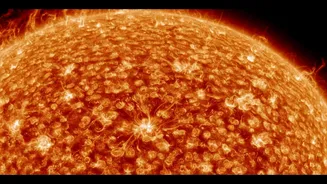
The breakthrough comes from the National Science Foundation's Daniel K. Inouye Solar Telescope in Hawaii. This instrument, the world's most powerful solar telescope, has captured the highest-resolution images of the Sun's surface to date. These images reveal the photosphere in astonishing detail, showing features as small as a city. The surface appears as a landscape of churning, cell-like structures known as granules. These are the tops of convection cells where hot plasma rises from the Sun's interior, cools off, and sinks back down. But the most exciting discovery lies at the edges of these granules.
Spotting Tiny Solar Whirlpools
For the first time, scientists have been able to see direct evidence of a phenomenon called the Kelvin-Helmholtz instability (KHI). This occurs when two fluids or plasmas moving at different speeds flow past each other, creating swirling vortices—like wind creating waves on water. The new images show these tiny, whirlpool-like motions happening continuously at the boundaries where the Sun's magnetic fields interact with the flowing plasma. Long hypothesized to exist on the Sun, these instabilities have now been unambiguously confirmed, providing a crucial piece of the energy transfer puzzle.
How Swirls Power the Corona
These KHI vortices are more than just a visual curiosity; they are believed to be a key mechanism for moving energy. As these swirls twist and churn the plasma, they also twist and braid the Sun's magnetic field lines. This process builds up immense tension and stores magnetic energy, much like twisting a rubber band. This energy can then be released upwards into the atmosphere. Scientists believe this process contributes to heating the corona, possibly through a cascade of small, constant explosions known as nanoflares. By mixing magnetized and non-magnetized plasma, these instabilities essentially act as engines that help transport energy from the dynamic surface into the quiet-looking but incredibly hot corona.
Why This Research Matters for Earth
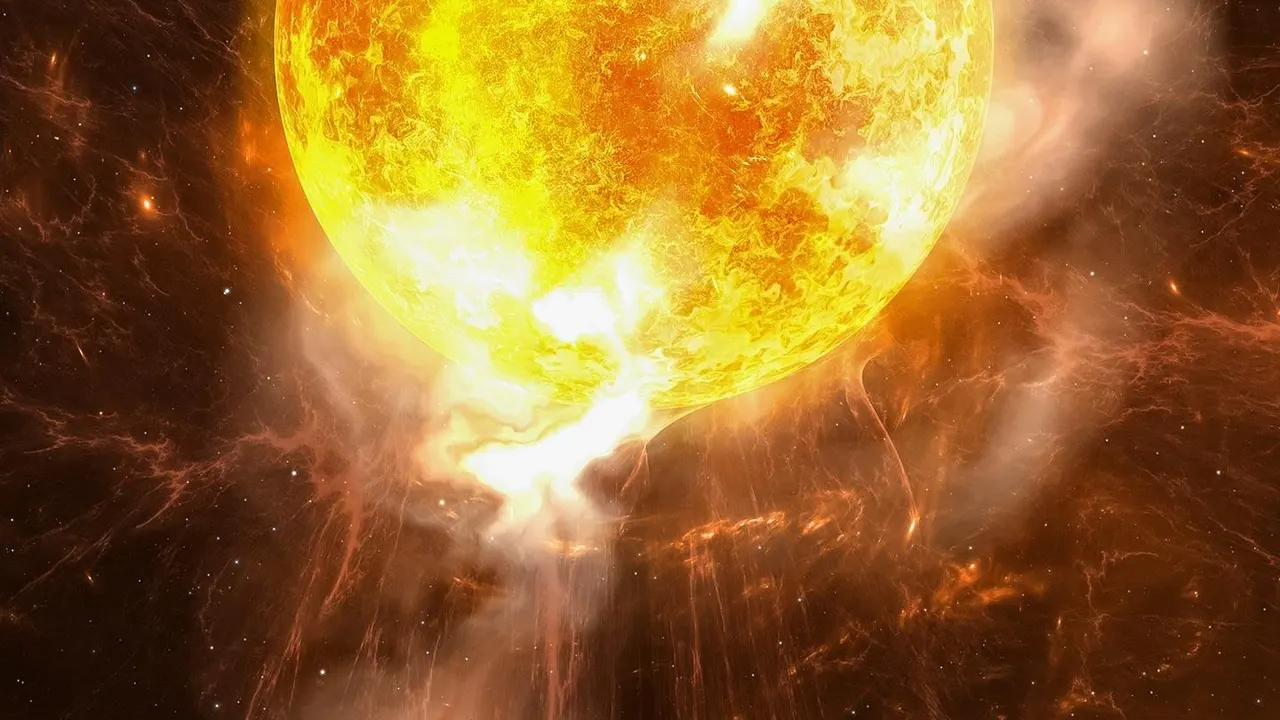
Understanding the fundamental physics of our star isn't just an academic exercise. The same magnetic processes that heat the corona also drive major solar events like flares and coronal mass ejections (CMEs). These powerful eruptions send torrents of charged particles and radiation into space, creating what is known as space weather. When directed at Earth, severe space weather can disrupt satellite communications, damage power grids, and pose a risk to astronauts. By observing the small-scale processes that lead to large-scale energy release, scientists can build better models to predict these events and protect our technology-dependent society.