






A Cultural and Financial Staple
For centuries, gold has been interwoven into the fabric of Indian life. It is a symbol of wealth, purity, and status, making it indispensable for weddings, festivals, and religious ceremonies. Beyond adornment, it serves as a crucial form of social security
and a tangible investment for millions of households, especially in rural areas where access to formal banking can be limited. This deep-rooted cultural affinity ensures that demand remains high, regardless of price fluctuations. It’s seen as a reliable store of value, a hedge against inflation, and a liquid asset that can be passed down through generations or sold in times of need. This unique role as both a consumer good and a financial asset is what makes India the world's second-largest consumer of gold.
The Economic Price of Precious Metal
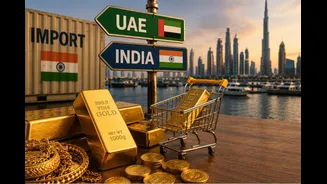
India’s love for gold has significant macroeconomic consequences. Since the country has negligible domestic gold production, it relies almost entirely on imports to satisfy its enormous appetite. These imports, paid for primarily in U.S. dollars, put a heavy strain on the nation's foreign exchange reserves. This contributes significantly to widening the Current Account Deficit (CAD), which is the gap between the country's total imports and exports. A wider CAD can weaken the Indian Rupee, making all other imports, including essential commodities like crude oil, more expensive. In fiscal year 2025-26, India's gold imports reached a staggering $71.98 billion, highlighting the scale of the issue. This outflow of capital for a largely unproductive asset—gold that sits idle in lockers—is a major concern for economic policymakers.
Enter Atmanirbhar Bharat
The 'Atmanirbhar Bharat' or self-reliant India initiative directly addresses this economic vulnerability. The government's goal is to reduce dependency on imports, and gold is a prime target. To achieve this, several strategies have been employed. High import duties, such as the hike to 15%, have been used to make imported gold more expensive and temper demand. More strategically, the government has been trying to bring the vast, privately held gold reserves—estimated to be over 25,000 tonnes—into the formal financial system. Initiatives like the Gold Monetisation Scheme (GMS) were launched to encourage households to deposit their idle gold with banks in exchange for interest. The idea is to recycle existing domestic gold to meet new demand, thereby reducing the need for fresh imports.
The Challenge of Changing Habits
Despite these efforts, the path to self-reliance in gold is fraught with challenges. The Gold Monetisation Scheme has seen limited success, mobilising only a tiny fraction of the country's household gold. Many people are reluctant to part with physical gold, especially heirloom jewellery, due to emotional attachment and a lack of trust in formal schemes. As of early 2026, only about 15% of household gold is estimated to be monetised, primarily through gold-backed loans rather than deposits. Recent changes have even seen the medium and long-term deposit options of the GMS discontinued, leaving only short-term bank deposits. Furthermore, while there are efforts to revive domestic mining in places like the Kolar Gold Fields, the potential output is a drop in the ocean compared to the annual demand.
From Ornament to Financial Asset
Interestingly, recent trends show a significant shift in how Indians are buying gold. While high prices have dampened jewellery demand, there has been a surge in investment demand. In the first quarter of 2026, investment demand (in the form of bars, coins, and Exchange Traded Funds or ETFs) actually outpaced jewellery demand for the first time. This indicates a growing sophistication among urban investors who are turning to gold as a financial instrument to hedge against market volatility, rather than just for cultural or ornamental purposes. This move towards financial forms of gold, such as Sovereign Gold Bonds and ETFs, aligns with the government's objectives, as it allows people to invest in gold without contributing to the physical import burden.