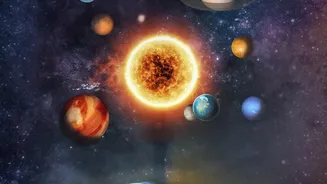

Where does the solar system end? For decades, we thought we had the answer. Now, a new proposal from leading scientists suggests the true boundary is far larger, shaped not just by our sun, but by the mysterious influence of dark matter.
Our Sun's Protective Bubble
To understand
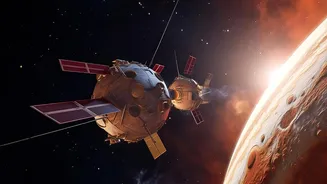
where our solar system might end, we first need to know how scientists define its edge today. The current, widely accepted boundary is called the heliopause. Think of it as the edge of a giant magnetic bubble, called the heliosphere, which is inflated by a constant stream of charged particles from our sun, known as the solar wind. This solar wind travels outwards past all the planets at supersonic speeds. Eventually, far beyond Pluto, it collides with the interstellar medium—the mix of gas and dust that fills the space between stars. The point where the solar wind is no longer strong enough to push back the interstellar medium is the heliopause. This is the functional 'border' of our solar system. NASA’s Voyager 1 and 2 spacecraft are the only human-made objects to have ever crossed this boundary, sending back invaluable data from interstellar space.
A New Gravitational Blueprint
A new proposal, however, suggests we should think bigger—much bigger. Former NASA chief scientist Jim Green and mathematician Ed Belbruno argue for a different definition of the solar system's boundary, one based on gravity. Instead of where the solar wind stops, they propose the boundary is the point where the sun's gravitational pull gives way to the larger gravitational pull of the entire Milky Way galaxy. This isn't just about the visible stars and gas in the galaxy. Crucially, their model incorporates the immense gravitational influence of dark matter, the invisible substance that makes up about 85% of the universe's mass. This redefinition pushes the edge of the solar system out to a staggering 3.8 light-years away, a distance so vast it’s nearly on the scale of the separation between our sun and its nearest stellar neighbours.
The Dark Matter Connection
So, what is dark matter, and why is it part of this conversation? Dark matter is one of the greatest mysteries in modern cosmology. We can't see it or touch it because it doesn’t seem to interact with light or any other form of electromagnetic radiation. Scientists know it exists because of its gravitational effects. Galaxies spin faster than they should if only visible matter were holding them together, and light from distant objects bends as it passes through space, revealing the presence of unseen mass. Essentially, dark matter is the invisible scaffolding that holds galaxies and the cosmic web together. According to the new theory, the total 'galactic force' influencing the outer solar system is a mix of gravity from normal matter and dark matter. By calculating this combined force, Green and Belbruno have mapped a new kind of boundary defined by gravitational balance.
Cosmic Gateways at the Edge
This revised model does more than just expand our cosmic address. It also predicts the existence of 'cosmic gateways' at this new frontier. The theory suggests that certain gravitationally stable regions, known as Lagrange points, could act as portals. These are locations where the gravitational pull of the sun and the galaxy effectively cancel each other out. Slow-moving interstellar objects, like comets from other star systems, could drift into these regions and become captured by our solar system’s gravity. This provides a compelling new framework for understanding how interstellar visitors arrive in our neighbourhood. It suggests our solar system is not a closed-off fortress but is constantly, if subtly, interacting with the wider galaxy through these gravitational pathways.
From Theory to Observation
For now, this remains a compelling theory. The next step is to find evidence. Green is in discussions with the team operating the New Horizons spacecraft, which famously flew past Pluto and is now exploring the outer reaches of the heliosphere. The hope is that the spacecraft could be used to observe these newly calculated Lagrange points. Even detecting an accumulation of interstellar dust in these specific regions could provide the first piece of evidence to support the calculations. Such an observation would not only help verify the new solar system boundary but could also offer a novel way to measure the distribution of dark matter within our own galaxy, turning a theoretical idea into a tangible discovery.