








From Blueprint to Detailed Map
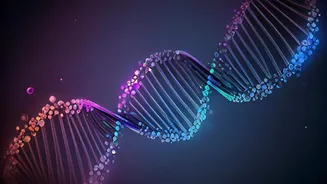
The human genome is vast, containing around three billion DNA base pairs. However, scientists have a relatively good understanding of only about 2% of it—the part that codes for proteins. The other 98%, often called non-coding DNA, has remained largely
a mystery. This is a problem, because tiny changes, or mutations, in this 'dark matter' of our genome can have significant effects on our health. A new tool from Google DeepMind, called the AlphaGenome Atlas, is designed to shed light on this. It acts as a comprehensive catalogue, predicting the potential impact of nearly every possible single-letter change across the entire human genome—all nine billion of them.
How the AI Predicts the Future of a Cell
At its core, the AlphaGenome Atlas is a massive database powered by an advanced AI model. Instead of scientists having to test the effect of every genetic variant in a lab—a practically impossible task—Google pre-calculated the predictions. The AI was trained on huge amounts of public genomic data to learn the complex rules of gene regulation. It can predict how a single DNA mutation might disrupt crucial molecular processes. To make this vast information usable, the system introduces a simple 'AVI' score (AlphaGenome Variant Impact score). This single number helps researchers quickly identify which genetic changes are most likely to be significant, separating harmless variations from potentially disease-causing ones.
A Game-Changer for Rare Diseases
One of the most immediate and powerful applications of this AI map is in the field of rare diseases. The average person has over 9,000 missense variants—a type of mutation—in their DNA, and most are harmless. When a patient presents with a mysterious illness, finding the one critical mutation responsible is like searching for a needle in a haystack. The AlphaGenome Atlas helps researchers drastically narrow down the list of suspects. For instance, scientists at the Broad Institute used the tool to prioritize variants for an unsolved rare disease case, and the AI correctly highlighted a critical mutation that helped solve the case. By predicting which changes are likely to be pathogenic, the AI allows scientists to focus their resources and accelerate the path to a diagnosis and potential treatment.
The Map is a Guide, Not the Destination
While incredibly powerful, it's crucial to understand the limitations. The AlphaGenome Atlas provides predictions, not definitive proof. An AI prediction that a variant may be harmful does not mean a person will certainly develop a disease. These insights must still be validated through experiments and clinical diagnosis, which requires evidence specific to each patient. Think of the AI as a highly intelligent assistant that can point scientists in the right direction, massively speeding up the initial discovery phase. It helps researchers form better hypotheses, but it does not replace the rigorous work of lab verification and clinical assessment.
The Dawn of True Precision Medicine
The release of the AlphaGenome Atlas marks a significant step towards the era of precision medicine. For the first time, researchers worldwide can access a comprehensive map of genetic variation by simply opening a web browser, with no coding skills required. This democratisation of complex genomic data could accelerate research across the board, from understanding cancer to developing new drugs tailored to an individual's genetic makeup. As Pushmeet Kohli of Google DeepMind put it, mapping the human genome was like buying a book we couldn't read. With tools like the AlphaGenome Atlas, we are finally learning to understand the language of life itself.