

Reading the Fossil Record of a Galaxy
Imagine trying to understand the history of a bustling city by studying its population. You would note where the youngest residents live to find the newest neighbourhoods, and where older generations are clustered to identify historic districts. Astronomers
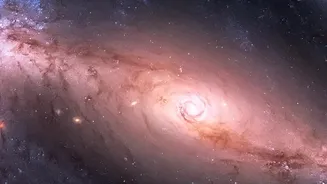
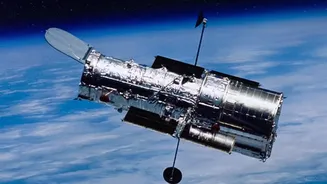
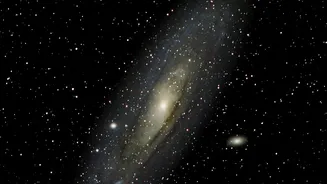
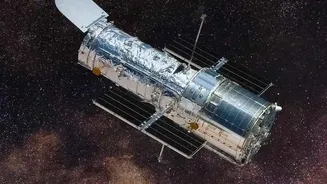
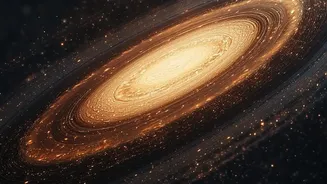
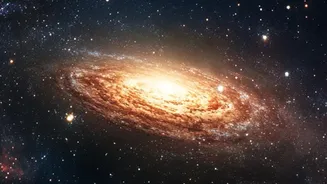
have just done something similar, but for a city of over a trillion stars: the Andromeda galaxy. Using the incredible resolving power of the Hubble Space Telescope, scientists conducted a massive survey, mapping about two-thirds of Andromeda's sprawling disc. The project, a combination of surveys called the Panchromatic Hubble Andromeda Treasury (PHAT), measured roughly 200 million individual stars. According to researchers, these stars are like a fossil record. By studying their colours—young, massive stars burn hot and blue, while older, smaller stars glow red—scientists can rewind time and map out the galaxy's history of star birth.
A Cosmic Slowdown
The findings, published in The Astrophysical Journal, paint a picture of a galaxy in a long, steady decline. Around 2 billion years ago, Andromeda experienced a major baby boom of stars, likely triggered by an encounter with another galaxy. But since then, the pace has slowed. The study confirms that star formation has been decreasing steadily for the last 500 million years. To put that in perspective, 500 million years ago, Andromeda was churning out stars at a rate of about one solar mass per year. By 40 million years ago, that rate had been cut in half. Today, it has fallen to just one-fifth of a solar mass annually. Most of this slowdown is happening in a prominent ring of gas and dust about 32,000 light-years from the galaxy's centre, which has historically been one of its most active star-forming regions.
Why is the Fire Dimming?
The most obvious reason for a slowdown in star birth would be that the galaxy is running out of fuel—the vast clouds of gas and dust needed to create new stars. However, the study suggests this isn't the case. Instead, it seems Andromeda is simply entering a quieter phase of its life, naturally winding down after its more boisterous youth. As one lead author described it, "It's just like after running a marathon, you need to take a breather." However, astronomers have a potential suspect for accelerating this process: M32, a small, compact satellite galaxy orbiting Andromeda. Researchers found that star formation in the part of Andromeda's disk near M32 began to drop off about 60 million years ago. While they can't definitively blame M32, its location makes it the "most likely suspect" for disrupting the gas clouds and helping to quench star birth in that region.
A Glimpse into the Milky Way's Future
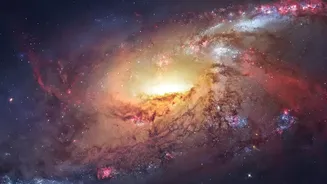
Studying Andromeda is more than just an academic exercise; it's like looking at a slightly older sibling of our own Milky Way galaxy. Its proximity, just 2.5 million light-years away, makes it the only large spiral galaxy we can study in such incredible detail, star by individual star. By observing Andromeda's transition from an active, star-forming galaxy to a quieter one, we get a preview of the evolutionary path that may lie ahead for the Milky Way. All galaxies eventually use up their gas and settle into a long retirement, their skies dominated by the red glow of aging stars. This new data helps us understand the timeline and mechanics of that process. Seeing Andromeda wind down gives us invaluable clues about the life cycle of galaxies and our own place within it.
An Uncertain Cosmic Collision
This discovery also adds a new layer to one of the most anticipated events in our cosmic future: the collision between the Milky Way and Andromeda. For years, this has been framed as an inevitable, head-on crash set to occur in about 4.5 billion years. However, more recent data has made this future less certain. Some newer simulations, incorporating data from the Gaia space telescope, suggest there is only a 50-50 chance of a direct collision within the next 10 billion years. The galaxies might instead have a near miss. Regardless of the exact outcome, the two galaxies are gravitationally bound. When they do eventually interact and merge, the state of their star-forming engines will determine what the new, combined galaxy will look like. Andromeda's slowdown means it will be a much quieter, less vibrant galaxy when it finally meets ours.