


Hunga Tonga-Hunga Haʻapai, Tonga (2022)
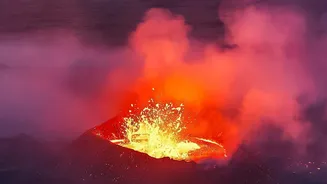
The eruption of the underwater Hunga Tonga-Hunga Haʻapai volcano on January 15, 2022, was the undisputed heavyweight champion of the 21st century. It was the largest explosive event recorded with modern instruments, registering a Volcanic Explosivity
Index (VEI) of 5 to 6. The blast was heard thousands of kilometres away in Alaska and generated an atmospheric shockwave that circled the globe multiple times. What made this event unique was its submarine nature; the interaction of magma with seawater created a colossal explosion that sent an ash plume soaring a record-breaking 58 kilometres into the atmosphere. It also injected an unprecedented amount of water vapour into the stratosphere, an event scientists are still studying for its long-term atmospheric effects. The eruption triggered a devastating tsunami with waves reaching up to 20 metres in Tonga, causing widespread damage and tragically, a few fatalities. Its power was staggering, with some estimates suggesting it was hundreds of times more powerful than the atomic bomb dropped on Hiroshima.
Puyehue-Cordón Caulle, Chile (2011)
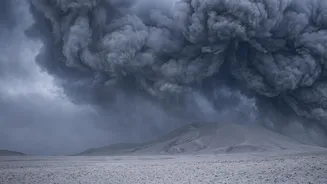
When the Puyehue-Cordón Caulle volcanic complex in Chile roared to life on June 4, 2011, it unleashed an enormous ash cloud that would cause travel chaos across the entire Southern Hemisphere. This VEI 5 eruption sent an estimated one hundred million tons of ash, sand, and pumice into the atmosphere. The fine, abrasive particles were carried by winds across South America, shutting down airports in Argentina, before continuing across the ocean. Within two weeks, the ash cloud had circumnavigated the globe, causing flight cancellations in Australia and New Zealand. The eruption forced the evacuation of around 3,500 people from the immediate vicinity in Chile. While not as explosive as the Tongan event, its sheer volume of ejected material and the vast distances the ash travelled demonstrated how a single eruption could have a prolonged and widespread impact on global aviation and local environments.
Mount Merapi, Indonesia (2010)
Power isn't just measured by explosive force, but also by impact on human life. The 2010 eruption of Mount Merapi in Java, Indonesia, was a stark reminder of this. Classified as a VEI 4 event, its significance lies in its deadly nature and the massive humanitarian response it required. Over several weeks starting in late October, Merapi, one of Indonesia's most active and dangerous volcanoes, unleashed a series of violent explosions, pyroclastic flows, and volcanic mudflows (lahars). These events led to the deaths of over 350 people and forced the evacuation of more than 350,000 residents living on its densely populated slopes. Ashfall disrupted life for hundreds of kilometres, closing airports and blanketing villages. The crisis prompted one of the largest-ever volcanic evacuations, highlighting the immense challenge of managing risk in regions where millions of people live in the shadow of active volcanoes.
Eyjafjallajökull, Iceland (2010)
Though relatively small in volcanic terms with a VEI of 4, the 2010 eruption of Iceland's Eyjafjallajökull became a global headline for a different reason: chaos. When the volcano erupted beneath a glacier, the interaction between meltwater and magma created a plume of very fine, glassy ash. This ash was then injected directly into the high-altitude jet stream and carried towards Europe, home to some of the world's busiest airspace. Fearing the abrasive ash would damage and disable jet engines, authorities took the unprecedented step of closing vast swathes of European airspace for nearly a week. This resulted in the cancellation of over 100,000 flights, stranding millions of passengers and costing the airline industry an estimated US$1.7 billion. The event became a case study in modern society's vulnerability to natural phenomena, demonstrating that even a mid-sized eruption in the right place can bring the globalized world to a standstill.