






A Celestial Oddball from the Start
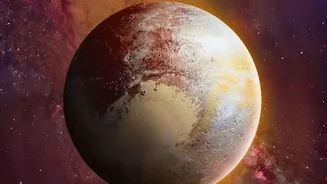
Ever since its discovery by Clyde Tombaugh in 1930, Pluto was the misfit of the planetary family. It’s smaller than Earth’s Moon and has a highly unusual orbit that is both tilted and so elliptical that it sometimes crosses Neptune's path. For decades,
these quirks made it an object of fascination, but also scientific scrutiny. Unlike the rocky terrestrial planets or the gas giants, Pluto seemed to belong to a different category altogether. This feeling only intensified as technology improved and astronomers began to realise that Pluto might not be alone in the far reaches of our solar system.
The Discovery That Changed Everything
The beginning of the end for Pluto’s planetary status came on January 5, 2005. A team of astronomers led by Mike Brown at Caltech discovered a new object far beyond Neptune. Initially dubbed 2003 UB313, it was later named Eris, after the Greek goddess of discord. The name was fitting, as Eris was found to be roughly the same size as Pluto and, at the time, was thought to be even more massive. The discovery created a crisis for astronomers: if Pluto was a planet, then Eris had to be one, too. And if Eris was a planet, how many more were out there waiting to be found? Suddenly, defining what a 'planet' truly is became an urgent necessity.
A Fateful Vote in Prague
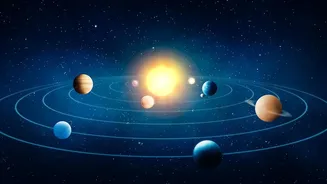
The debate came to a head in August 2006 at the International Astronomical Union (IAU) General Assembly in Prague. After intense discussion, the members present voted on a formal definition for a planet for the first time. They established three criteria a celestial body must meet to be considered a planet: it must orbit the Sun, it must be massive enough to be pulled into a nearly round shape by its own gravity, and it must have “cleared the neighbourhood” around its orbit.
The Rule That Pluto Broke
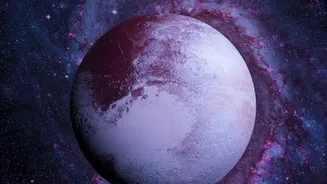
Pluto successfully met the first two conditions. It orbits the Sun and it's round. However, it failed on the third criterion. “Clearing the neighbourhood” means the object has become gravitationally dominant, sweeping up or pushing away other objects in its orbital path. Pluto shares its orbit with many other icy bodies in a region known as the Kuiper Belt. Because it hasn't cleared this orbital zone, the IAU voted to reclassify it. On that day, Pluto was officially designated the prototype for a new category: dwarf planets. Ceres, Eris, and later Haumea and Makemake would join it in this new class.
A Universe of Controversy
The decision was met with immediate public outcry and sharp division among scientists. Alan Stern, the principal investigator of NASA's New Horizons mission to Pluto, called the vote an embarrassment, noting that only 424 of the world’s roughly 10,000 astronomers were present to vote. Critics argued the third criterion was poorly defined; after all, Earth, Mars, and Jupiter also share their orbits with asteroids. The cultural impact was significant, as “plutoed”—meaning to demote or devalue something—was named the 2006 Word of the Year.
Pluto's Magnificent Comeback
The debate was reignited in 2015 when NASA's New Horizons spacecraft flew by Pluto, revealing a world far more complex and dynamic than anyone had imagined. The images sent back showed towering mountains of water ice, vast plains of nitrogen, and a thin blue atmosphere. It looked, for all intents and purposes, like a planet. To many scientists, this geological complexity is more important than an object's ability to clear its orbit. As a result, the debate over Pluto’s status continues to this day, with prominent scientists and even NASA's chief occasionally calling for its planethood to be reinstated.