






An Extraordinary Discovery
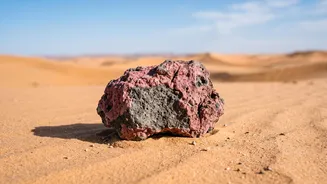
In 2022, meteorite hunters discovered a nearly two-pound (about 800-gram) pinkish rock on a salt plain in Mali. Named Teghaza 001, it looked unusual, but its true significance was not revealed until scientists got a closer look. Initial analysis confirmed
its origin was not of this world. By studying oxygen isotopes—a kind of chemical fingerprint—researchers at the University of New Mexico matched the rock to other known Martian meteorites. This confirmed it was a genuine piece of Mars, one of only about 435 such rocks ever found on Earth. But Teghaza 001 was far from ordinary. It was what one scientist called a 'Rosetta Stone' for Mars.
A Messenger From Early Mars
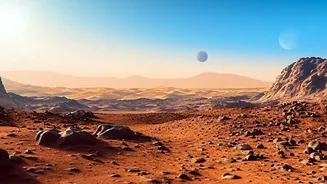
What makes Teghaza 001 so special is its incredible age. By analysing tiny zircon crystals embedded in the rock, which act like geological clocks, scientists determined it formed over 4.1 billion years ago. This places its creation in the very early history of Mars, when our own planet, Earth, was just seeing the beginnings of life. The meteorite is a sample from Mars's Noachian era, a period from which very few samples exist. Unlike other ancient Martian rocks found on Earth, like ALH84001, which is made of a single mineral, Teghaza 001 contains a rich mixture of igneous minerals. This variety tells a complex story of how the planet's crust first formed from cooling magma and was then altered over time.
The Long Journey to Earth
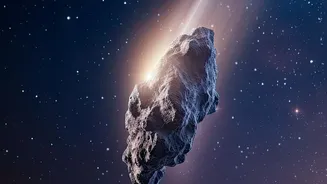
The journey of a Martian rock to Earth is a violent and lengthy process. It begins with a massive asteroid or comet impact on Mars powerful enough to blast chunks of the surface into space, overcoming the planet's gravity. This is easier on Mars than on Earth because its gravity is weaker and its atmosphere is much thinner. Once in space, these rocks can orbit the Sun for millions of years before some are eventually captured by Earth's gravity and fall to the surface as meteorites. The exact crater from which Teghaza 001 was launched is unknown, but its mineral composition closely matches observations by NASA's Mars Reconnaissance Orbiter of the planet's heavily cratered and ancient southern highlands.
Clues of an Ancient Water World
Perhaps the most exciting discovery within Teghaza 001 is the clear evidence that its minerals were altered by water. Analysis shows that liquid water interacted with the rock around 4.1 billion years ago, suggesting Mars had a more dynamic water cycle much earlier than previously believed. This doesn't mean the meteorite contains proof of life, but it confirms the presence of liquid water—a key ingredient for habitability—on the surface or subsurface of the young planet. The stone records the interaction of water and rock, and possibly even an imprint of the Martian atmosphere as the planet began to lose its water. These findings help scientists understand why Mars became the cold, dry world it is today, while Earth remained wet.
A Window into Planetary Formation
Teghaza 001 is providing more than just a history of Mars; it is a sample of a completely new part of the Martian crust scientists have never been able to study before. Its unique chemical composition is distinct from the several hundred other Martian meteorites in our collections, which are mostly much younger. The rock is believed to have formed from magma deep in the Martian mantle that later became part of the crust. By studying this pristine piece of planetary building block, researchers can test and refine their models of how terrestrial planets like Mars and Earth form and evolve. The analysis has only just begun, but this rose-coloured messenger from Mars has already started to rewrite our understanding of the Red Planet's origins.