






The Quake and the Immediate Response
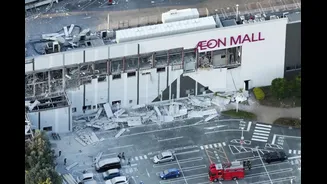
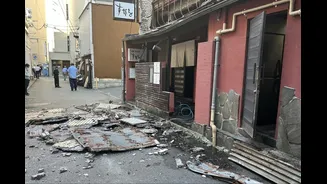
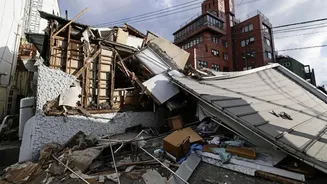
The quake struck in the afternoon at a shallow depth of 10 kilometers in the Kumamoto prefecture, a region familiar with seismic devastation. Immediately, the sophisticated gears of Japan’s emergency apparatus began to turn. The Japan Meteorological Agency
(JMA) issued a tsunami advisory for waves of up to one meter along the coasts of the Ariake and Yatsushiro Seas. Across seven prefectures, alerts flashed on phones and television screens, urging residents in coastal areas to move to higher ground. While the warning was later lifted after a couple of hours, the rapid, automatic nature of the alert demonstrates a system designed with one principle in mind: there is no room for hesitation.
Forged in Tragedy: The 2011 Turning Point
To understand Japan’s seriousness, one must look back to March 11, 2011. A massive 9.0-magnitude undersea earthquake triggered a catastrophic tsunami that claimed around 18,500 lives and caused the Fukushima nuclear disaster. In the immediate aftermath, initial tsunami warnings were found to have tragically underestimated the size of the incoming waves. While the first alert came within three minutes, it took nearly half an hour to upgrade the warning to reflect the true, monstrous scale of the tsunami, by which time some coastal areas were already hit. This disaster became a painful, transformative lesson. It exposed weaknesses and spurred a complete overhaul of the nation's tsunami warning system, with a renewed focus on avoiding underestimation at all costs.
A System Rebuilt for Speed and Clarity
Following the 2011 disaster, Japan invested heavily in upgrading its warning infrastructure. The JMA now operates a dense network of over a thousand seismographs, GPS buoys, and seafloor sensors that provide real-time data. The system is designed to issue initial warnings within three minutes of a major quake. For extremely large earthquakes (magnitude 8.0 or higher), the system now issues warnings with qualitative descriptions like "Huge" or "High" instead of specific numbers, to prevent the public from underestimating the threat based on an initial, potentially inaccurate height estimate. This change directly addresses the failures of 2011, when some residents may have felt a false sense of security based on the first, lower wave height predictions.
More Than Tech: A Culture of Preparedness
Technology is only half the story. Japan's resilience is built on a deeply ingrained culture of disaster readiness. From a young age, children participate in regular evacuation drills at school, learning to protect their own lives and then, as they get older, the lives of those in their community. This education extends to the entire society, with communities holding joint drills, creating local disaster maps, and managing evacuation shelters. This 'bottom-up' approach ensures that when an official alert is issued, the public is not just a passive recipient of information but an active participant in its own safety. The calm and orderly evacuations seen during alerts are a direct result of this relentless, lifelong training.