







A Heart More Active Than We Knew
The story begins at Sputnik Planitia, the vast, western lobe of Pluto's iconic heart feature, Tombaugh Regio. This enormous basin, larger than Texas and Oklahoma combined, is filled with frozen nitrogen ice. When NASA's New Horizons spacecraft flew past
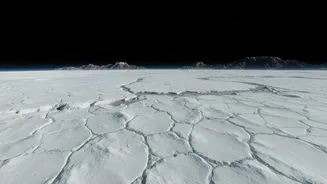
in 2015, it revealed a stunningly youthful surface, almost entirely free of impact craters. This lack of craters suggested the surface was being actively renewed, a shocking discovery for a world so far from the sun's warmth. The surface is carved into city-sized polygonal cells, hinting that the ice is slowly churning like a thick soup in a process called convection.
The Telltale Streaks
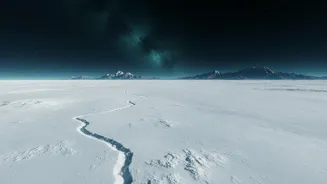
A new, deeper analysis of those decade-old New Horizons images has revealed something even more remarkable. Scientists noticed dark, linear streaks and more diffuse patches tracing the boundaries of Sputnik Planitia's northern convection cells. The research team, led by New Horizons principal investigator Alan Stern, compared these patterns to features on Earth's own Greenland ice sheet. On Earth, similar dark patterns are created where liquid water has wetted the surface. But on Pluto, where surface temperatures hover around a frigid -230°C, liquid water is impossible, and the thin atmosphere means liquid nitrogen rain is also out of the question.
Eruptions of Liquid Nitrogen
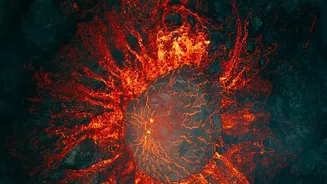
If the liquid isn't coming from above, the only other possibility is that it's coming from below. The leading theory is that heat from Pluto's interior, combined with immense pressure at the base of the kilometers-deep glacier, is causing the nitrogen ice to melt. This liquid nitrogen, being less dense than the solid ice above it, would then be pushed upward. Computer models suggest this liquid could travel through narrow cracks or conduits in the ice, similar to how magma rises through Earth's crust. It would then erupt onto the surface, flowing briefly before refreezing, darkening the ice as it spreads. This is the first time evidence for recently flowing liquid has been found on Pluto's surface.
A 'Time-Variable' World
The discovery suggests that Pluto's surface is not just slowly changing, but that it might have features that change over shorter, more dynamic timescales. "Pluto never stops surprising us," said Alan Stern of the Southwest Research Institute. "In addition to suggesting that liquids have recently expressed themselves on Pluto's surface, this result also suggests a new kind of time-variable feature on Pluto." This process is a form of cryovolcanism—or cold volcanism—where volatiles like nitrogen erupt instead of molten rock. These findings could also help explain similar mysterious features, like the geysers observed on Neptune's moon Triton.
Rewriting Planetary Science
This research fundamentally changes our view of geological activity in the solar system. It was once thought that only large, rocky worlds close to the sun could be geologically active. Pluto proves that even small, icy bodies in the distant, frozen Kuiper Belt can have dynamic inner lives. The evidence for a subsurface process capable of melting nitrogen ice and forcing it to the surface suggests that Pluto may retain more internal heat than previously thought. While the evidence for these nitrogen flows is still indirect and based on interpreting images and models, it opens up a tantalizing new picture of Pluto as a complex and evolving world. The discovery is a powerful motivation for further study of how materials behave in these extreme, cold environments.