



A Ghostly Echo from the Past
Imagine looking at the sky and seeing the echo of an explosion that happened centuries ago. That's essentially what astronomers have done. They've discovered a massive, cone-shaped cavity in the cold molecular gas near the center of our galaxy. This void,
stretching roughly three light-years, is believed to be the lasting imprint of a powerful wind or jet of high-energy particles blasted out from Sagittarius A (Sgr A) long ago. For decades, scientists theorized that such outflows must exist, as they are seen in more active galaxies, but finding direct evidence in our relatively placid Milky Way proved elusive. Today, Sgr A is one of the dimmest supermassive black holes known, making this discovery a fascinating look into its more turbulent youth.
Cosmic Detective Work
So how do you find evidence of an ancient outburst from 26,000 light-years away? The answer lies in using the universe as a giant recording device. Astronomers used powerful instruments like the Atacama Large Millimeter/submillimeter Array (ALMA) in Chile and space-based X-ray observatories like NASA's Chandra and ESA's INTEGRAL telescope. These telescopes can detect different kinds of light and energy. ALMA provided an incredibly detailed map of the cold gas around Sgr A, revealing the empty cavity. Meanwhile, X-ray and gamma-ray telescopes detected a 'light echo'. Giant gas clouds, like Sagittarius B2, are located hundreds of light-years away from the black hole. They are now glowing in X-rays, illuminated by a powerful burst of energy that left Sgr A centuries ago and is only just reaching them. By studying this reflected light, scientists can reconstruct the black hole's past activity.
The Black Hole's 'Burp'
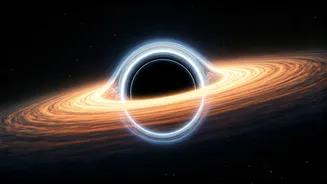
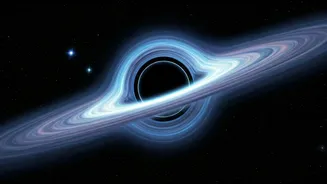
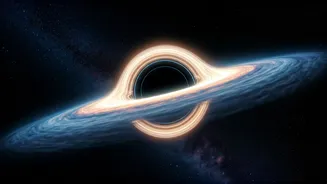
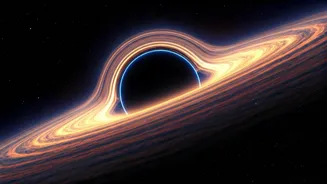
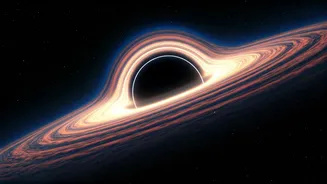
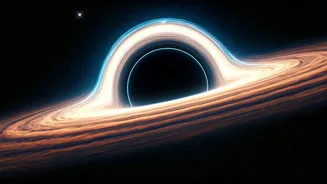
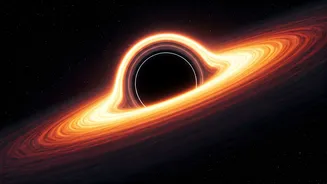
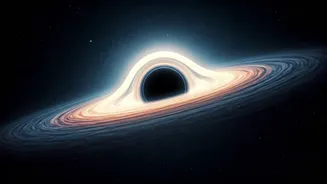
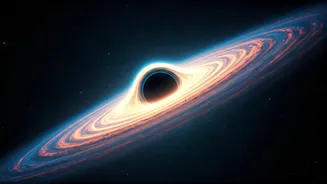
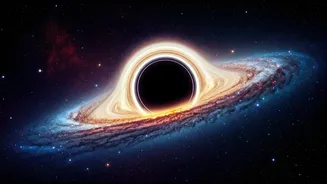
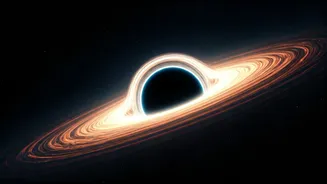
Supermassive black holes are not cosmic vacuum cleaners that suck everything in. As matter like gas and dust gets pulled towards a black hole, it forms a swirling, superheated disc around it. While much of this material falls in, some is violently ejected back into space in the form of powerful winds or focused jets. Scientists believe this is what created the cavity. A powerful outflow from Sgr A acted like a cosmic snowplow, either pushing the cold molecular gas out of the way or heating it up so much that it became invisible to the telescopes looking for it. Evidence from several telescopes suggests Sgr A has had multiple such active phases, with one major event occurring just a few hundred years ago, when it was a million times more energetic than it is today.
Why This Discovery Matters
Finding this 'scar' near our galaxy's heart does more than solve a 50-year-old mystery. It fundamentally changes our understanding of the Milky Way's evolution. These outflows from black holes are crucial architects of their galaxies. They regulate star formation by clearing out the gas that stars are born from, and they distribute heavy elements far and wide. This discovery confirms that our own black hole, despite its current quiet state, has played an active role in shaping the galactic center. It also provides clues about the black hole's own history. The orientation of these jets suggests Sgr A* has grown steadily over billions of years without major collisions with other large black holes. It gives us a unique window into the typical, quiet life of a supermassive black hole, which is actually their dominant state across the universe.