



A River Runs Through It
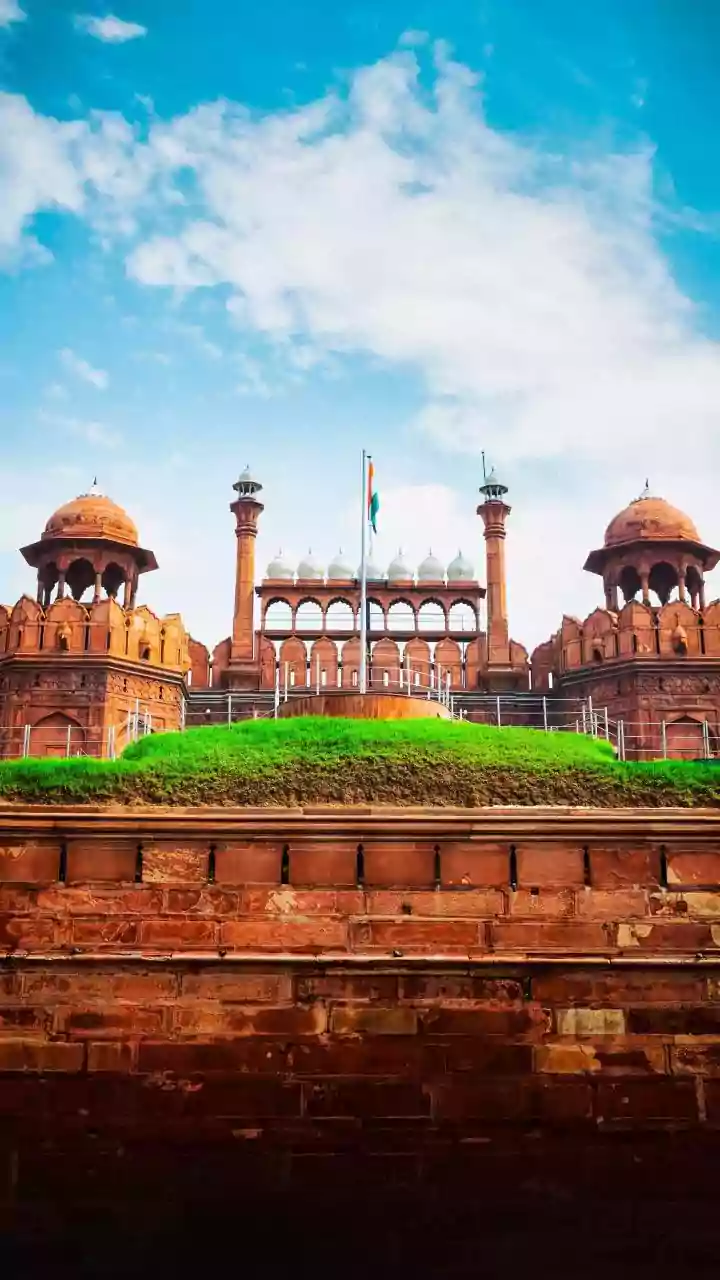
When Emperor Shah Jahan decided to move his capital from Agra to a new city, Shahjahanabad, in 1639, the Yamuna river was central to his vision. The Red Fort, or Qila-e-Mubarak (the Fortunate Citadel), was built on its western bank, allowing the river to serve
as a natural defence and a vital water source. More than just a utility, the river was the aesthetic anchor for the palace's most exclusive quarters. A sophisticated channel of water known as the Nahr-i-Bihisht, or 'Stream of Paradise', was drawn from the Yamuna and flowed through the centre of the imperial private apartments. This continuous water channel connected the pavilions, cooled the air, and created an earthly reflection of the paradise described in the Quran, turning the entire complex into a self-contained haven.
The Emperor's Inner Sanctum: Khas Mahal
The heart of the emperor's private life was the Khas Mahal, or 'Private Palace'. This opulent marble building was divided into three main sections. The Tasbih-Khana was a chamber for private prayer and contemplation. The Khwabgah was the serene sleeping chamber. The Baithak or Tosh-Khana served as a sitting room or wardrobe. The interiors were exquisitely decorated with carved marble and floral patterns painted in vibrant colours, with a ceiling that was once gilded. From the Khas Mahal's eastern side projects the Muthamman Burj, an octagonal tower where the emperor would appear daily before his subjects in the Jharokha Darshan ceremony, a powerful ritual connecting the ruler to his people.
Where Colour Lived: The Rang Mahal
South of the emperor's personal apartments lay the Rang Mahal, or 'Palace of Colour', considered the crowning jewel of the imperial seraglio or zenana (women's quarters). This was the largest of the royal apartments, designated as the main residence for the emperor's wives and concubines. True to its name, it was once brightly painted and decorated with a mosaic of mirrors, earning it the nickname 'Shish Mahal' or Palace of Mirrors. The life-giving Nahr-i-Bihisht flowed through its centre, feeding a beautiful marble basin carved in the shape of a lotus blossom. From its five windows on the eastern wall, the ladies of the court could discreetly watch the elephant fights and military spectacles held on the river flats below.
The Hall of Private Audience: Diwan-i-Khas
To the north of the Khas Mahal stood the Diwan-i-Khas, the 'Hall of Private Audiences'. While not strictly a living space, it was a crucial extension of the emperor's private domain. It was here, in this marble-pillared hall, that Shah Jahan would meet with his most important courtiers, state guests, and foreign dignitaries to discuss sensitive matters. It was a space of immense power and unparalleled luxury, famously intended to house the legendary Peacock Throne before its capture by Nadir Shah. An inscription by the poet Amir Khusrow running along its cornice perfectly captures the Mughal ambition for this space: "If there be a paradise on earth, it is this, it is this, it is this."
A Lost Connection to the River
Today, visitors to the Red Fort find it hard to imagine this intimate riverside setting. Over the centuries, the Yamuna has shifted its course eastward. What was once a riverbed where royal spectacles took place is now the busy Ring Road, separating the fort from the water that was once its lifeblood. The systematic demolition of many structures by the British after 1857 also dismantled much of the connective tissue between the pavilions. While the marble halls remain, they are now silent shells. The cooling breeze from the river, the gurgle of the 'Stream of Paradise', and the vibrant life of the Mughal court are left to our imagination.