






Propulsion Without Propellant
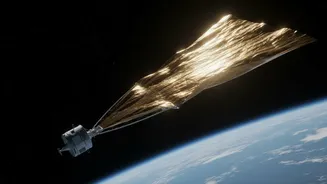
A solar sail works by capturing the momentum from photons, which are particles of light from the sun. While each individual photon provides only a minuscule push, the constant stream of them bouncing off a huge, mirror-like sail adds up. Over time, this
gentle, continuous acceleration can propel a spacecraft to incredible speeds without using a single drop of conventional rocket fuel. This propellant-free approach eliminates the need for heavy, bulky fuel tanks, enabling longer, more ambitious, and lower-cost missions to explore our solar system and beyond. The concept has been proven by missions like Japan's IKAROS and The Planetary Society's LightSail 2, which successfully used sunlight to change its orbit around Earth.
The Incredible Shrinking Sail
The first major challenge is a packaging problem. A functional solar sail needs a vast surface area—often the size of a small apartment or even a basketball court—to catch enough sunlight. However, space on a rocket during launch is extremely limited and expensive. The solution is to make the entire system coilable. The sail itself, made of a material like Mylar or polyimide that is thinner than a human hair, must be folded with incredible precision. The structural supports, known as booms, must also be collapsible. Recent advancements, particularly in NASA's Advanced Composite Solar Sail System (ACS3) mission, have focused on creating booms from lightweight composite materials. These carbon-fiber-reinforced polymer booms can be squashed flat and rolled up like a tape measure, fitting into a spacecraft sometimes no larger than a toaster oven.
The Peril of Deployment
Getting a tightly packed sail into orbit is only half the battle. The second, and perhaps greater, challenge is deploying it reliably. In the vacuum of space, a fragile, expansive structure must unfurl perfectly without tearing, tangling, or failing to lock into place. The process involves motors and mechanisms that unspool the booms, which in turn pull the folded sail quadrants taut. This transition from a compact bundle to a fully deployed, flat sail is one of the most critical and delicate phases of any solar sail mission. A failure at this stage, such as a jam in the deployment mechanism or an uneven unfurling that causes the spacecraft to tumble, can render the entire mission useless. Even subtle issues, like a slight bend in a boom, can affect how the sail performs.
Next-Generation Solutions
Engineers are tackling these challenges with innovative materials and designs. The composite booms tested by NASA's ACS3 mission are not only 75% lighter than previous metallic designs but also far more resistant to warping from the extreme temperature changes in space. This thermal stability is crucial for maintaining the sail's precise shape, which is necessary for navigation. By angling the sail relative to the sun, a spacecraft can steer and change its orbit, much like a sailboat tacks in the wind. Data gathered from missions like ACS3, which launched in April 2024, will inform the design of even larger sails, potentially up to half the size of a football field. These future systems could be used for advanced applications like early warnings for space weather events or as communication relays for crewed missions to the Moon and Mars.