






An Explorer for a New Generation
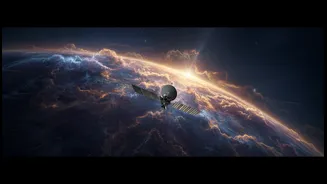
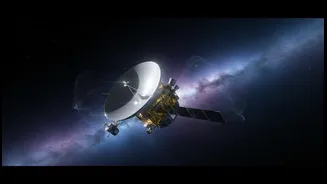
Launched in 2006, New Horizons is one of humanity’s most ambitious robotic explorers. Many remember its stunning success in 2015, when it gave us our first-ever close-up look at the dwarf planet Pluto and its moons, revealing a complex world of ice mountains
and frozen plains. Four years later, it broke its own record by flying past Arrokoth, the most distant object ever explored by a spacecraft. But its journey was far from over. Having completed its primary goals, New Horizons is now on an extended mission, pushing deeper into a region called the Kuiper Belt, a vast donut-shaped ring of icy bodies left over from the formation of our solar system. Currently over 9.5 billion kilometres from Earth, the probe has now been given a new, profound task: to investigate the very edge of the sun’s influence.
The Sun’s Protective Bubble
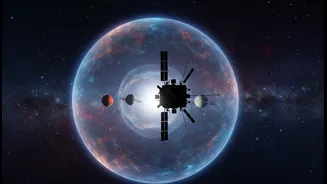
Our solar system isn't just empty space with planets orbiting the sun. It’s enveloped in a giant, protective bubble called the heliosphere. This bubble is created by the solar wind, a constant stream of charged particles flowing outward from the sun at supersonic speeds of around 1.6 million kilometres per hour. The heliosphere acts as a massive shield, protecting the planets, including Earth, from a significant amount of harsh galactic cosmic radiation coming from interstellar space. Without this magnetic bubble, life on our planet would be exposed to far more dangerous energy particles from distant supernovae and other cosmic events. But this bubble doesn't extend forever. Far out in space, it meets the pressure of the interstellar medium—the gas and dust that fills the space between star systems.
Where the Solar Wind Hits the Brakes
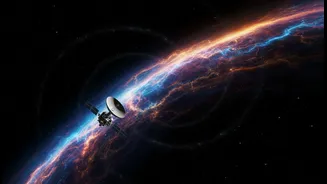
The boundary the New Horizons probe will study is a region known as the termination shock. This isn't a solid wall, but a vast area where the solar wind, after its long journey from the sun, finally begins to slow down dramatically as it collides with particles from interstellar space. As interstellar gas atoms seep into our heliosphere, they collide with the solar wind particles, adding mass and causing a gradual deceleration. Scientists have already used New Horizons data to confirm that the solar wind slows by 13-15% by the time it reaches the probe's current position. The termination shock is where this slowdown becomes abrupt. Data from the Voyager 2 spacecraft, which crossed this boundary in 2007, showed the solar wind speed dropped by a staggering 46%. New Horizons is expected to encounter this critical boundary sometime between 2029 and 2040.
A New Mission Objective
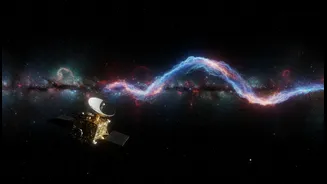
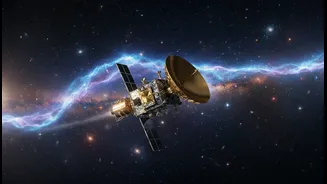
After waking from a nearly year-long hibernation in June 2026 to conserve power, New Horizons is now actively sending back data. Its new mission, jointly managed by NASA's Planetary Science and Heliophysics divisions, is to use its sensitive instruments to measure the particles and plasma in this distant region. Instruments like the Solar Wind Around Pluto (SWAP) will provide unprecedented data on how the solar wind behaves as it approaches the termination shock. While the two Voyager probes crossed this boundary decades ago, they lacked the modern, more sensitive instruments that New Horizons carries. The data collected will be a treasure trove for scientists, offering a more detailed understanding of this vast, invisible frontier. These measurements are crucial for creating better models of our solar system’s shield and how it interacts with the galaxy around it.
Racing Toward the Interstellar Void
The mission is a race against time. The spacecraft is travelling at roughly 480 million kilometres per year, but its power source, a radioisotope thermoelectric generator, is slowly decaying. Scientists are hopeful the probe will remain operational long enough to cross the termination shock and provide a close-up look. The exact location of this boundary fluctuates with the sun's 11-year activity cycle, expanding when the sun is active and contracting when it's calm, which is why the predicted crossing date has such a wide window. Studying this boundary isn't just an academic exercise; it has practical implications. Understanding the heliosphere's edge helps predict the radiation exposure astronauts might face on future deep-space missions to Mars and beyond. It also provides a model for understanding the protective 'astrospheres' around other stars in our galaxy.