



Meet IMAP: Our New Celestial Cartographer
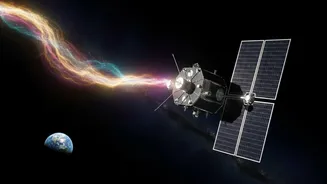
Launched in September 2025, NASA's Interstellar Mapping and Acceleration Probe, or IMAP, is on a mission to chart the unknown. Positioned about 1.5 million kilometres from Earth towards the Sun, it has an unobstructed view of the solar wind—a constant
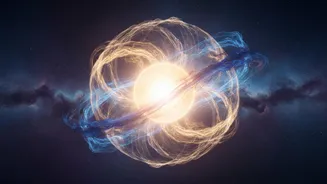
stream of particles flowing from the Sun. IMAP was built to do something remarkable: map the boundaries of our heliosphere. This is the vast bubble created by the solar wind as it pushes against the material of interstellar space. The spacecraft is equipped with ten advanced scientific instruments, each designed to sample and analyze different particles, from those originating from the Sun to the dust from exploded stars far away.
What Is the Solar Bubble?
Imagine the Sun as the engine of a massive ship traveling through the galaxy. The solar wind is its wake, creating a bubble-like region around all the planets. This bubble, called the heliosphere, is our solar system's first line of defense. It shields us from a significant amount of harsh galactic cosmic radiation coming from the rest of the galaxy. This protective barrier extends billions of miles, far beyond the orbit of Pluto. For decades, scientists have relied on limited data from probes like Voyager and the Interstellar Boundary Explorer (IBEX) to understand this crucial shield. IMAP is the next generation, designed to create a comprehensive, 3D map of this immense, invisible structure.
The First Data Is In
In a milestone for heliophysics, NASA recently announced the first public release of science data from the IMAP mission. After beginning its primary science mission on February 1, 2026, the spacecraft's instruments have been diligently collecting information. This first batch of data, collected through April 2026, comes from seven of IMAP's ten instruments, including those that measure the solar wind's ions and electrons, the interplanetary magnetic field, and interstellar dust. While scientists have only just begun to analyze this initial treasure trove, it represents a new era in understanding our cosmic neighborhood. The data is now publicly available for scientists around the world to study.
Why This New Map Matters
Mapping the heliosphere isn't just about satisfying cosmic curiosity. Understanding its structure and how it interacts with the interstellar medium has profound practical implications. The data helps scientists better understand space weather—the changing conditions in space driven by the Sun's activity. Severe space weather can disrupt satellites, impact power grids on Earth, and pose a risk to astronauts. With its real-time data stream, called I-ALiRT, IMAP provides forecasters with advanced warning of incoming solar energetic particles, offering roughly a 30-minute heads-up for potentially hazardous events. This is crucial for protecting our technological infrastructure and for the safety of future crewed missions to the Moon and Mars.
What's Next for IMAP?
This first data release is just the beginning of a two-year primary mission. Every six months, IMAP will complete a scan of the entire sky, creating successive maps that will show how the heliosphere breathes and changes in response to the Sun's 11-year activity cycle. The three instruments whose data has not yet been released are the ones responsible for creating the global maps by detecting energetic neutral atoms (ENAs). These particles are created at the very edge of the solar system and travel all the way back to IMAP, carrying information about the distant boundary. As more data is collected and analyzed, scientists expect to answer fundamental questions about how our Sun interacts with the galaxy and how our solar system evolved.