


The Solar System’s Oddball
Imagine the solar system forming from a giant, swirling disc of gas and dust. As this disc spun, it imparted a default rotational direction to the planets that coalesced from it. That’s why, when viewed from above the Sun's north pole, nearly every planet spins
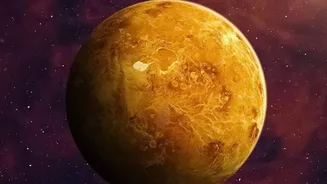
counter-clockwise, a direction known as prograde motion. But Venus is different. It spins clockwise, a motion called retrograde rotation. This makes it a true outlier, a planet where the sun rises in the west and sets in the east, albeit very, very slowly. It's not entirely alone in its strangeness—Uranus is tilted so far over it practically rolls on its side—but Venus’s deliberate backward spin has long been one of the greatest puzzles for astronomers.
A Day Longer Than A Year
Adding to its mystique is the sheer length of a Venusian day. It takes Venus a staggering 243 Earth days to complete a single rotation on its axis. In contrast, its journey around the Sun, a Venusian year, takes only about 225 Earth days. This means a day on Venus is actually longer than its year, a feature unique in our solar system. This sluggish, backward spin is so peculiar that scientists have spent decades trying to figure out what could have pushed Venus so far from the planetary norm. The answers they've come up with are as dramatic as they are fascinating.
Theory 1: A Cosmic Collision
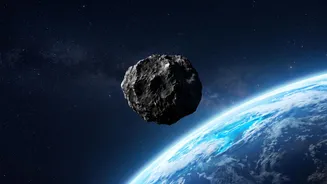
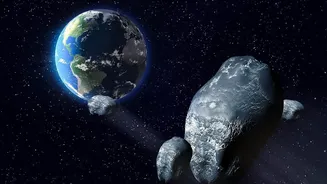
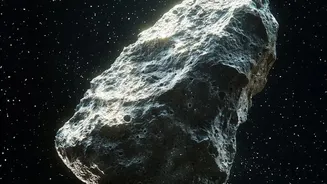
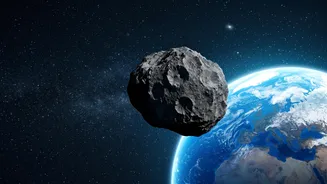
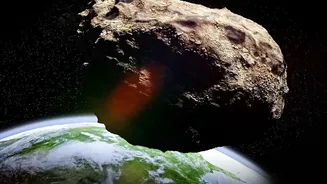
One of the most prominent theories suggests a violent past for Venus. In the chaotic early days of the solar system, when large, planet-sized objects were still careening through space, Venus may have been struck by a massive body. According to this hypothesis, a collision with an object possibly the size of the Moon, or even another protoplanet, could have been powerful enough to not only slow Venus’s original spin to a halt but to completely reverse it. Such impacts were not uncommon; a similar event is thought to have created Earth’s Moon. For Venus, the lasting scar of this ancient catastrophe might be its strange, backward rotation.
Theory 2: The Weight of The Atmosphere
An alternative theory suggests the culprit wasn’t a single violent event, but a slow, persistent process spanning billions of years. Venus is shrouded in an incredibly dense atmosphere, about 90 times thicker than Earth’s, which whips around the planet much faster than the planet itself spins. This thick blanket of gas is heated intensely by the Sun, creating powerful atmospheric waves known as thermal tides. Over eons, the gravitational pull of the Sun on this heavy, flowing atmosphere could have created a torque, or twisting force, strong enough to act like a brake. Scientists suggest this atmospheric drag could have gradually slowed Venus’s original prograde rotation, brought it to a standstill, and then slowly nudged it into its current retrograde spin.
An Unsettled Scientific Debate
So, was it a cataclysmic smash-up or the relentless push of its own atmosphere? The truth is, scientists are still not entirely sure, and the answer could even be a combination of both. Some models suggest an initial impact might have altered Venus's spin, with atmospheric and tidal forces later refining it into its current, stable state. What is clear is that Venus is a world of extremes, where the atmosphere is so powerful it has an intimate connection to the planet's rotation, affecting everything from its day length to its climate. It reminds us that even within our own solar system, there are still fundamental mysteries waiting to be solved.