





What is a Fire Rainbow?
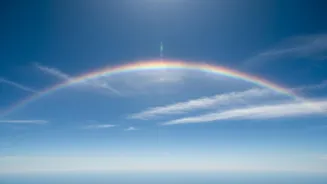
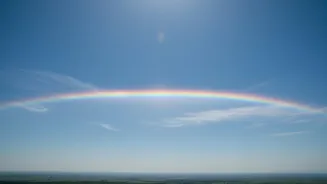
First, let's clear the air. The captivating phenomenon popularly known as a 'fire rainbow' is neither fire nor a rainbow. Its scientific name is a circumhorizontal arc. The name 'fire rainbow' comes from its flame-like appearance, with vibrant pastel
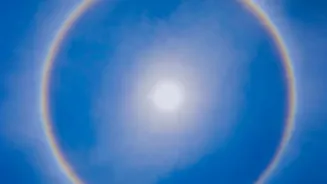
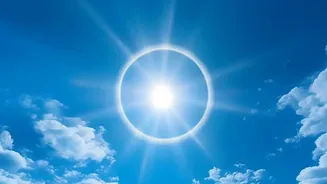
colours looking like they're painted across the sky. However, the name is misleading. The effect is an atmospheric optical illusion created by light interacting with ice crystals, not fire or rain. These arcs are part of a larger family of phenomena called ice halos.
The Chilly Recipe for Fiery Colours
The creation of a circumhorizontal arc requires a very specific set of ingredients, making it a relatively rare sight. It all starts high in the atmosphere, at altitudes of over 6,000 metres (about 20,000 feet), where wispy cirrus clouds form. At this height, the temperature is so low that these clouds are not made of water droplets, but millions of tiny, plate-shaped hexagonal ice crystals. For the magic to happen, these ice crystals must be aligned horizontally, parallel to the ground, like tiny floating plates.
A Perfect Alignment of Sun and Ice
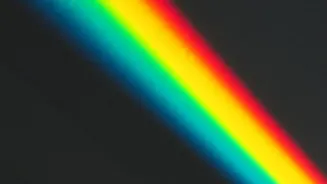
Having the right clouds is only half the battle. The other crucial element is the sun's position in the sky. A circumhorizontal arc will only form when the sun is very high, at an altitude of more than 58 degrees above the horizon. When these conditions are met, sunlight enters the vertical side of a horizontally-oriented ice crystal and exits through its bottom face. This path bends the light, acting like a giant, natural prism. As the light refracts, it splits into its component wavelengths, fanning out into the distinct, pure colours of the spectrum that we see from the ground.
Location, Location, Location
The strict requirement for a high sun means that you can't see a circumhorizontal arc just anywhere. This phenomenon is most commonly seen in the mid-latitudes. In fact, it is impossible to see them at locations north of 55°N or south of 55°S. This is because the sun never gets high enough in the sky at those higher latitudes. For places like London, the window of opportunity is limited to about 140 hours during the peak summer months. In contrast, a city like Los Angeles has around 670 hours per year where the sun is high enough. For observers in India, which lies well within the ideal latitudes, these arcs are more likely to be visible, especially during the summer months when the sun is at its highest point in the sky around midday.
Not to Be Confused With...
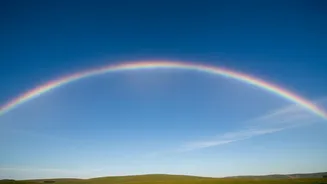
The sky can play many tricks on the eyes, and the circumhorizontal arc has a few lookalikes. It's often confused with cloud iridescence, which also creates rainbow-like colours in clouds. However, iridescence is caused by light diffracting through water droplets or smaller ice crystals and results in more random, pastel patches of colour, often closer to the sun. A circumhorizontal arc, by contrast, has a clear colour separation, with red always on top, and it runs parallel to the horizon. It's also distinct from a traditional rainbow, which is caused by the reflection and refraction of light in liquid water droplets and always appears in the sky opposite the sun.