

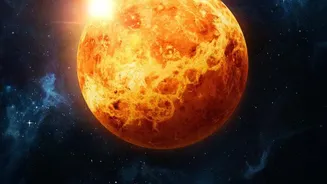
A New View of Our Star
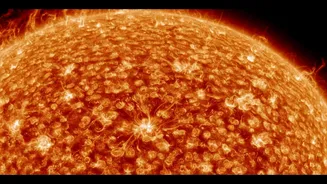
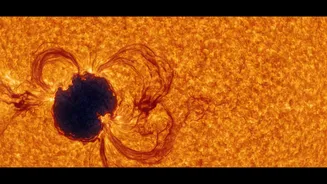
Scientists have captured the most detailed image of the sun's surface ever taken in visible light. Captured by the Daniel K. Inouye Solar Telescope in Hawaii, the images are so clear that they can show features on the sun's surface as small as a city.
What they reveal is breathtaking: a landscape of cell-like structures, called granules, which are vast bubbles of hot plasma, each about the size of a large country on Earth. This plasma, a superheated state of matter, constantly churns as it brings heat from the sun's interior to the surface. For the first time, these images have allowed scientists to see tiny, swirling whirlpools and stripe-like patterns at the edges of these granules, a phenomenon never directly observed before on the solar surface.
The Coronal Heating Puzzle
For decades, one of the biggest puzzles in astrophysics has been the 'coronal heating problem'. Logically, the sun should be hottest at its core and coolest at its outer layers. While its visible surface, or photosphere, is about 6,000°C, its outer atmosphere, the corona, sizzles at a staggering two million degrees Celsius. How energy is transported from the colder surface to the much hotter corona has stumped scientists for nearly a century. The sun is made of plasma, a mix of charged particles that creates and is influenced by powerful magnetic fields. Scientists have long suspected the answer to the heating problem lies in how energy is transferred through this magnetised plasma, but they couldn't see it happen.
Seeing the Sun's Engine at Work
This is where the new, sharp images become crucial. The newly spotted swirls and vortices are the first direct confirmation of a process called the Kelvin-Helmholtz instability on the sun's surface. This instability happens when two streams of fluid—or in this case, plasma—flow past each other at different speeds, creating waves and swirls. We see this same effect in swirling clouds and waves on the ocean. On the sun, these tiny whirlpools, driven by the churning plasma, are powerful enough to twist and braid the sun's magnetic field lines. This tangling of magnetic fields acts like twisting a rubber band, storing immense energy which is then explosively released. Scientists believe this constant, small-scale process could be the source of 'nanoflares'—tiny but numerous explosions that, in aggregate, could provide the enormous energy needed to heat the corona.
Why Solar Secrets Matter on Earth
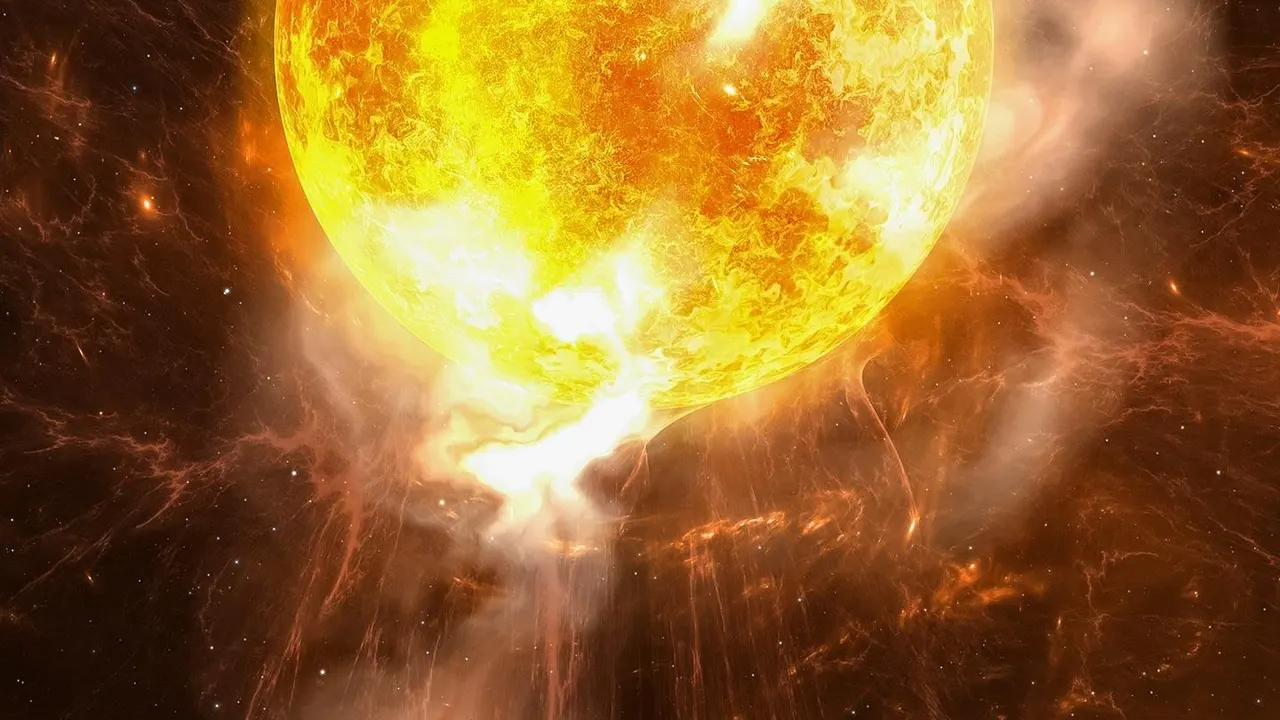
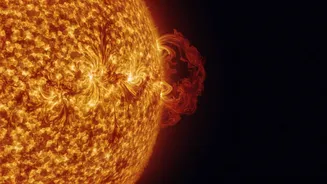
Understanding how our sun works is not just an academic exercise. The same magnetic forces that may heat the corona also power massive solar flares and coronal mass ejections (CMEs). These solar storms hurl enormous amounts of charged particles into space. When aimed at Earth, this 'space weather' can disrupt and damage our critical infrastructure. It can knock out communications satellites, which are vital for everything from television broadcasts to weather forecasting used by Indian agencies. It can also endanger GPS navigation systems and even cause widespread blackouts by overloading power grids. By understanding the fundamental physics behind energy release on the sun, even at these newly observed microscopic scales, scientists can build better models to predict space weather. This gives us a better chance to protect our increasingly technology-dependent world from the sun's most violent outbursts.