



The Puzzles of Our Sister Planet
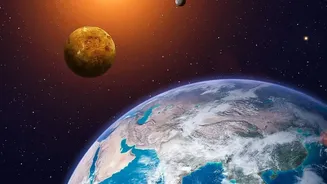
For decades, scientists have been fascinated and perplexed by Venus. It shares a similar size, mass, and rocky composition with Earth, yet it could not be more different. Its atmosphere is a thick, crushing blanket of carbon dioxide, and surface temperatures
are hot enough to melt lead. Beyond these hellish conditions, two facts have long stood out as major astronomical puzzles. First, Venus has no moon. Second, its rotation is incredibly strange. A single day on Venus lasts 243 Earth days, which is longer than its 225-day year. It also spins backwards relative to Earth and most other planets in our solar system. Previous theories suggested a massive impact might be responsible for this retrograde rotation, but a complete explanation has remained elusive.
A Ghost in the Simulation
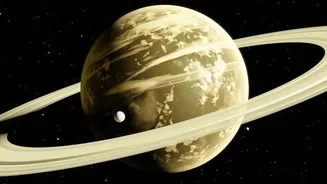
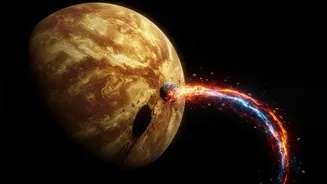
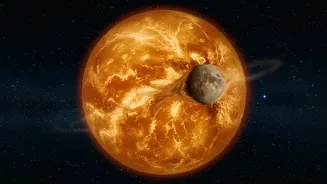
A new study published in The Astrophysical Journal provides a compelling, if brutal, new theory. Research led by astrophysicist Stephen Kane from the University of California, Riverside, suggests Venus may have once had a moon, only to see it destroyed by the planet itself. Using sophisticated computer simulations, the researchers modelled how a hypothetical Venusian moon would interact with its parent planet over time. Previous theories often relied on a massive external catastrophe, like a giant asteroid impact, to explain the missing moon. However, Kane's research suggests that no external disaster was needed. “It turns out the gravity of the planet itself combined with the rate at which it spins naturally caused the moon to collapse on top of it,” he explained.
A Deadly Tidal Dance
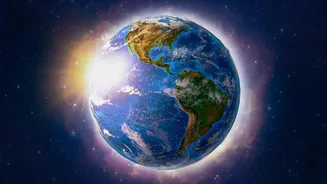
The fate of a moon is determined by a complex gravitational dance with its planet, governed by tidal forces. Earth’s relatively fast rotation transfers energy to our Moon, causing it to slowly drift away from us at a rate of about four centimetres per year. The new simulations showed that for Venus, the opposite would have been true. Because of Venus's incredibly sluggish rotation, the tidal interaction would have worked in reverse. Instead of pushing a moon away, the planet’s gravity would have relentlessly pulled it inward. The models showed that in most scenarios, a Venusian moon would be doomed to a death spiral, migrating closer and closer until it ultimately crashed into the planet.
One Theory to Explain It All
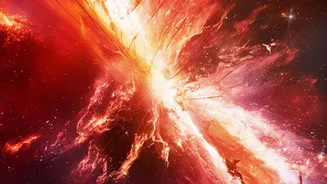
The impact of this collision would have been cataclysmic. Such an event would not just explain the missing moon but could also solve the puzzle of Venus's strange rotation. The massive transfer of energy and momentum from a colliding moon could have been enough to dramatically slow the planet's original spin and even flip its direction, resulting in the slow, retrograde motion observed today. While the simulations don't prove Venus ever had a moon, they offer a powerful and unified explanation for two of its most enduring mysteries. The results suggest that for slowly rotating rocky planets, keeping a large moon might be the exception, not the rule. This finding has implications not just for our solar system, but for the search for habitable, Earth-like planets orbiting other stars.