





A Monumental Feat of Engineering
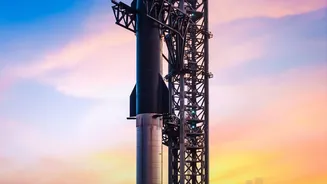
On November 14, 2026, after a 22-hour mission that saw it circle the Earth 14 times, the Starship upper stage, known as Ship 42, descended through the atmosphere and navigated itself back to its launch site. Instead of landing on legs, the towering stainless-steel
vehicle performed a complex flip maneuver and was caught securely by two massive arms on the launch tower, a system nicknamed 'Mechazilla'. This marked the very first time an orbital-class upper stage has been recovered this way, a moment hailed as the 'holy grail of spaceflight' by SpaceX commentators. While the mission plan also included catching the Super Heavy booster, an automated abort diverted it to a splashdown in the Gulf of Mexico after a fuel alarm. However, the successful recovery of the Starship itself is the main prize, proving a revolutionary concept can work in practice.
How the 'Chopstick' Catch Works
The idea behind Mechazilla is both simple and audacious: put the landing gear on the ground, not on the rocket. Traditional rockets, and even SpaceX's own Falcon 9, require heavy landing legs to touch down safely. These legs are dead weight for most of the mission, reducing the amount of payload the rocket can carry. By moving the catch mechanism to the tower, Starship can eliminate this weight, dedicating more of its mass to cargo, fuel, or crew. The process is a high-stakes mechanical ballet. The returning Starship uses its fins to steer itself like a skydiver, re-enters the atmosphere at immense speed, and then fires its Raptor engines at the last moment to flip upright and slow its descent. It must arrive at a precise point in space between the 'chopstick' arms, which then close to secure the vehicle.
The Quest for Rapid Reusability
Catching the rocket is not just a spectacular trick; it is the cornerstone of SpaceX’s business model for Starship. The goal is full and rapid reusability, much like a commercial airplane. While the Space Shuttle was partially reusable, its components required months of expensive and intensive refurbishment between flights. SpaceX’s Falcon 9 booster landings transformed the launch industry, but its upper stage is still discarded on every flight. Starship is designed to change that. By catching both the Super Heavy booster and the Starship upper stage at the launch tower, SpaceX aims to inspect, refuel, and relaunch them in a matter of hours or days, not months. This airplane-like operational tempo could drastically reduce the cost of access to space, making ambitious projects like large-scale satellite deployment and interplanetary travel economically viable.
What This Means for the Future
This successful catch is a critical step toward realizing SpaceX's grandest ambitions. A fully reusable Starship is essential for deploying the next generation of the Starlink internet constellation and for building a sustainable human presence on the Moon and Mars. NASA is relying on a version of Starship to land its Artemis astronauts on the lunar surface, a mission that requires multiple orbital refueling flights—a feat only practical with a rapidly reusable fleet. The Flight 15 catch moves Starship from a developmental vehicle to one with proven recovery architecture. The next steps will be to inspect the returned vehicle, assess the wear and tear from its orbital journey, and work toward reflying it. SpaceX still needs to demonstrate that it can catch both stages on a single flight and turn the vehicles around quickly. One successful catch is a proof of concept; making it routine is the next great challenge.