

The Danger in the Sky
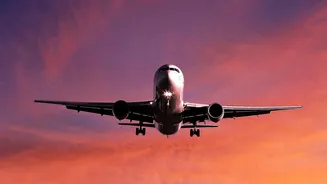
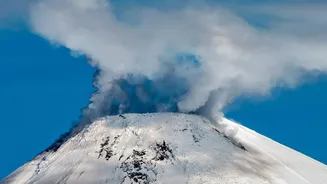
To an airline pilot, volcanic ash is one of the greatest natural hazards. It isn't like the soft soot from a fire; it’s a cloud of tiny, jagged particles of rock and glass. When a jet flies through this, the abrasive particles can sandblast cockpit windows,
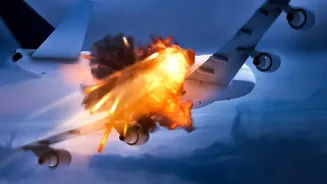
rendering them opaque. More dangerously, when these particles are sucked into a jet engine, the high temperatures inside the combustion chamber can melt them into a glassy substance. This molten silica then sticks to crucial components like turbine blades, solidifying and potentially causing the engine to stall or fail completely. The ash can also contaminate fuel and air systems and block critical sensors that measure airspeed and altitude. Because ash clouds can be hard to distinguish from regular weather clouds, especially at night, avoidance is the only safe strategy.
A Child of a Cataclysm
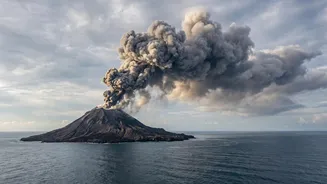
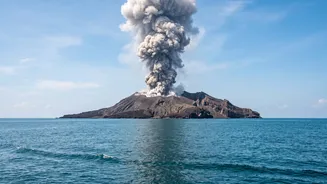
Anak Krakatau means “Child of Krakatoa” in Indonesian. It’s a fitting name, as the volcanic island emerged from the sea in 1927, rising from the caldera left by the catastrophic 1883 eruption of Krakatoa—an event so powerful it triggered global cooling and tsunamis that killed over 36,000 people. Anak Krakatau has carried on its parent’s volatile legacy. It sits in one of the world's most seismically active zones, the Pacific Ring of Fire. A 2018 eruption caused a section of the volcano to collapse, triggering a tsunami that killed more than 400 people. Its frequent and explosive activity makes it a constant source of concern for geologists and the aviation industry alike.
A Recent History of Disruption
The threat from Anak Krakatau is not hypothetical. In early September 2026, a series of powerful eruptions sent ash plumes soaring as high as 50,000 feet—well into the cruising altitude of commercial airliners. The fallout was immediate and widespread. As ash spread across the region, authorities were forced to close at least seven airports, including Jakarta's main international hub, Soekarno-Hatta. The closures had a massive ripple effect, impacting an estimated 341,000 passengers as nearly 3,000 flights were cancelled, delayed, or diverted over several days. This recent event demonstrates how quickly the volcano can bring one of the world's busiest air travel corridors to a grinding halt.
How Authorities Track the Threat
Monitoring volcanic ash is a global effort. A network of nine Volcanic Ash Advisory Centers (VAACs) around the world uses satellite imagery, pilot reports, and ground-based observations to track the movement of ash clouds. The region around Anak Krakatau is monitored by the VAAC in Darwin, Australia. When an eruption occurs, the VAAC issues advisories that predict the ash cloud's trajectory and altitude. Airlines and air traffic controllers use these advisories to make critical safety decisions, including whether to cancel flights, close airports, or reroute planes on long-haul journeys to avoid the hazardous airspace.
The Ripple Effect for Indian Travellers
While Indonesia may seem far away, an eruption from Anak Krakatau can have a direct impact on travellers from India. The flight paths for many popular routes from Indian cities to Southeast Asia and Australia pass through or near Indonesian airspace. Destinations like Singapore, Bali, and Australian cities such as Sydney and Melbourne are all potentially affected. During the September 2026 eruption, Singapore Airlines cancelled numerous flights to Jakarta. For Indian travellers, this can mean sudden cancellations, lengthy delays, or longer flight times as aircraft are rerouted around the vast ash clouds, adding hours and uncertainty to their journeys. The interconnected nature of global aviation means that a single volcano can cause disruptions that are felt thousands of kilometres away.