







The idea of bringing extinct animals back to life has leaped from cinema screens into real-world laboratories. A company called Colossal Biosciences is using AI and genetics to do just that, drawing inevitable and frequent comparisons to 'Jurassic Park'.
Science Fiction vs. Scientific Fact
The comparison to 'Jurassic Park' is one Colossal's CEO, Ben Lamm, acknowledges, but he is quick to separate Hollywood fiction from scientific mission. For one, there will be no dinosaurs. Their DNA is far too old and degraded to ever be viable. Instead, Colossal is focused on more recently lost species like the woolly mammoth, dodo, and thylacine (Tasmanian tiger). Their flagship project is resurrecting the woolly mammoth, or rather, creating a functional proxy. The goal is not to clone a mammoth from a mosquito trapped in amber, but to edit the DNA of its closest living relative, the Asian elephant. Using the gene-editing tool CRISPR, scientists aim to give an elephant the key traits of a mammoth, such as a shaggy coat, small ears, and the ability to thrive in the cold. The result will technically be a hybrid—an elephant-mammoth mix—that looks and acts like its extinct counterpart.
The Crucial Role of AI
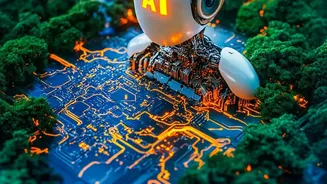
This is where artificial intelligence becomes critical. Ancient DNA recovered from fossils is fragmented and incomplete. AI helps scientists piece these genetic fragments together, identify key genes, and compare them to the genome of a living relative, like the Asian elephant. The AI can rapidly pinpoint the genetic differences that code for specific traits, essentially creating a roadmap for the gene-editing process. This computational power dramatically speeds up what would otherwise be an impossibly complex task, managing the vast datasets required for genome reconstruction. Beyond de-extinction, Colossal also uses AI for modern conservation, such as building bioacoustic monitoring systems to track and protect elusive living species like the tooth-billed pigeon and wild wolves in Yellowstone.
Life Finds a Way… Or Does It?
Just like in the movie, Colossal's work raises profound ethical questions. While the company has already announced the birth of dire wolf-like pups, some scientists argue these are just genetically modified gray wolves, not true resurrections. Critics voice concerns about animal welfare, the high failure rates associated with cloning and genetic modification, and the unforeseen consequences of introducing these animals into modern ecosystems. Could they become invasive? Would they suffer in a world that has changed dramatically since they last roamed it? There is also the 'moral hazard' argument: the fear that if extinction is seen as reversible, it could weaken the urgency of protecting the species we still have.
Why Do It At All?
Colossal's stated mission is not just to revive species but to restore ecosystems. The company argues that reintroducing 'keystone' species like the mammoth could have significant environmental benefits. For example, they believe herds of mammoth-like creatures could help restore the Arctic grasslands, which could in turn help combat climate change by keeping the permafrost frozen. Beyond the ecological goals, there is a clear business and technological drive. The tools and techniques developed for de-extinction—from advanced gene-editing to artificial wombs—have applications in human healthcare and present-day conservation. For instance, research on the mammoth project has already provided insights that are being used to create a vaccine for a deadly elephant herpesvirus.