



An Inventory of Ice
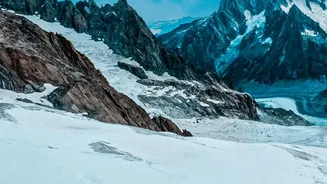
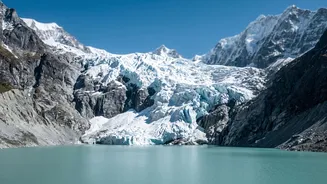
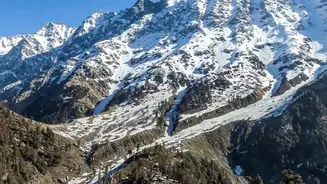
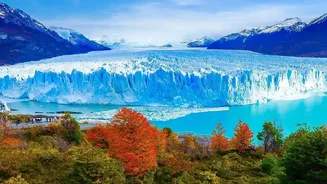
The Himalayan state of Uttarakhand is a water tower for a significant part of North India, with inventories identifying nearly 1,500 glaciers within its boundaries. These massive rivers of ice feed major river systems, including the Ganga and Yamuna,
supporting agriculture, hydropower, and daily life for millions downstream. The sheer scale of this cryosphere is breathtaking, but it also masks a complex and evolving set of risks. While the slow retreat of major glaciers has been a long-standing concern, scientists are now focusing on a more immediate and unpredictable danger posed by a particular type of ice formation that behaves very differently from the valley glaciers we often imagine.
What is a Hanging Glacier?
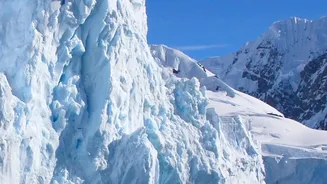
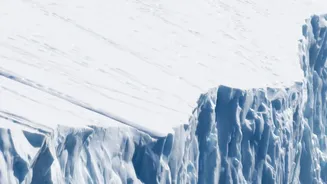
Unlike a typical valley glacier that flows slowly and steadily downwards, a hanging glacier is an ice mass perched precariously on a very steep mountain slope or cliff edge. Because the incline is too sharp for a gentle flow, these glaciers often terminate abruptly. Instead of melting gradually at a terminus far down in a valley, their instability causes them to break off. This process of detachment is a natural part of their lifecycle, but it turns into a significant hazard when huge blocks of ice and rock collapse suddenly into the valleys below, where communities and critical infrastructure are often located. A recent study focusing on just the Alaknanda basin in Uttarakhand identified 219 such hanging glaciers, highlighting the scale of this specific phenomenon.
A Cascade of Catastrophe
The primary danger of a hanging glacier is the suddenness and violence of its collapse. A detachment can trigger a massive ice and rock avalanche, a colossal debris flow that moves at incredible speed. The 2021 Chamoli disaster was a harrowing example, where a large chunk of rock and hanging ice broke away, creating a devastating flood in the Rishiganga and Dhauliganga rivers. The danger is often twofold. First, the avalanche itself can be powerful enough to obliterate anything in its path. Second, the falling debris can crash into a river or a glacial lake, creating a temporary dam. When the immense water pressure inevitably breaches this unstable barrier, it can trigger a secondary, even more destructive event known as a Glacial Lake Outburst Flood (GLOF), sending a wall of water, mud, and boulders downstream.
The Climate Change Connection
The stability of these hanging glaciers is being critically undermined by climate change. The Himalayan region is warming at a rate nearly twice the global average, leading to profound changes in the cryosphere. According to scientists at the Wadia Institute of Himalayan Geology, this accelerated warming leads to repeated cycles of freezing and thawing. This process acts like a wedge, creating and expanding fractures within the ice and weakening the bond between the glacier and the rock it clings to. Over time, this makes the ice mass increasingly unstable and a collapse more probable. What might have been a rare natural event is becoming a more frequent threat in a rapidly warming world.
The Race to Monitor the Risk
Recognizing the growing threat, Indian scientific bodies are in a race against time. Institutions like the Wadia Institute of Himalayan Geology and the National Disaster Management Authority (NDMA) are working to map and monitor these high-risk glaciers. Studies using satellite imagery and hazard modeling have begun to create inventories of the most dangerous locations, particularly in vulnerable areas like the Alaknanda basin. However, the challenge is immense. Unlike the European Alps, where high-risk glaciers are often equipped with advanced monitoring systems, the vast and rugged terrain of the Himalayas makes such intensive observation difficult. The risk is further compounded by a rapid increase in infrastructure and settlements in these fragile zones, with some projections showing a 120% increase in at-risk infrastructure land by 2030 compared to 2000.