



A Call from the Kuiper Belt
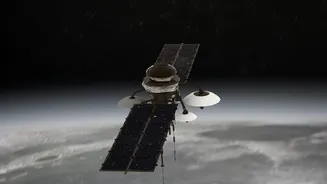
On June 23, 2026, flight controllers at the Johns Hopkins Applied Physics Laboratory confirmed that the New Horizons spacecraft had successfully awakened from a 321-day hibernation period. The probe, acting on commands sent nearly a year earlier, powered
up its systems and sent a status update back home. That confirmation signal, traveling at the speed of light, took approximately 8 hours and 52 minutes to cross the 9.5 billion kilometers (5.9 billion miles) separating the spacecraft from Earth. This routine procedure is anything but ordinary; it’s a conversation held across a chasm of space so vast that a round-trip message—a question and its answer—requires nearly an entire day.
The Tyranny of Cosmic Distance
Why the incredible delay? It's a simple, yet profound, function of distance. New Horizons is currently more than 64 times farther from the Sun than Earth is. At that range, even light, the fastest thing in the universe, feels slow. To put its journey into perspective, when the spacecraft flew past Pluto in 2015, the signal time was a mere 4.5 hours. Its continued voyage into the Kuiper Belt—a donut-shaped ring of icy objects beyond Neptune—has nearly doubled that communication gap. Every week during its long slumber, the probe sent a simple 'green' status beacon, a faint pulse assuring mission control that all was well across the billions of kilometers.
A Groundbreaking Journey So Far
This wake-up call is just the latest milestone in a historic mission. Launched in 2006, New Horizons completed the initial reconnaissance of the classical planets with its breathtaking 2015 flyby of Pluto. It revealed a world far more complex and geologically active than ever imagined, with nitrogen glaciers, vast mountains of water ice, and a thin blue atmosphere. Four years later, on New Year's Day 2019, it made history again by performing the most distant flyby ever, capturing stunning images of Arrokoth, a 'contact binary' object that looks like a reddish snowman. This encounter provided an unprecedented look at one of the primitive building blocks of our solar system.
An Observatory at the Solar System's Edge
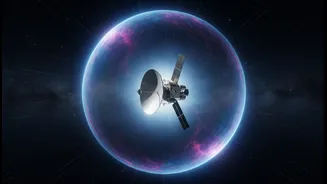
Even while hibernating, New Horizons was hard at work. Its instruments continued to gather data on the plasma environment and dust particles in the outer heliosphere—the vast bubble created by the Sun's solar wind. Now fully active, the spacecraft will begin transmitting this science data, offering new insights into a region only visited by the Voyager probes before it. In the coming weeks, its ultraviolet spectrograph will observe the distribution of hydrogen gas at the edge of the solar system. The mission is effectively an observatory in the Kuiper Belt, studying distant objects and the very fabric of space in ways impossible from Earth.
The Long Goodbye
New Horizons is speeding away from us at a rate of about 300 million miles per year, a silent ambassador in the cosmic sea. Its mission is expected to continue until at least 2028 or 2029, when it will finally exit the Kuiper Belt. The probe's nuclear power source, a radioisotope thermoelectric generator, provides ever-dwindling energy, and engineers are planning software updates to maximize every last watt. Eventually, like the Voyager probes before it, New Horizons will fall silent, continuing its journey into interstellar space. It will carry the legacy of human curiosity with it, a testament to our desire to see what lies beyond the horizon.