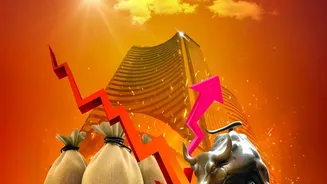









The Daily Market Drama
Financial news often focuses on short-term movements, using dramatic language to describe normal market volatility. Headlines about a market 'plunge' or 'surge' create a sense of urgency that can be hard to ignore. This constant stream of information
makes it feel like you need to act immediately. However, most of these daily fluctuations are just noise and have little bearing on the long-term trajectory of a diversified portfolio. Short-term volatility is an expected feature of investing, not necessarily a sign that your entire strategy needs to change. Historically, markets have always recovered from short-term disruptions, rewarding investors who remain disciplined.
Your Brain on Bad News
Our brains are wired to react strongly to negative information. This psychological phenomenon, known as 'loss aversion', means we feel the pain of a loss about twice as intensely as the pleasure from an equivalent gain. This bias makes us vulnerable to panic selling during a downturn. Financial headlines often trigger other cognitive biases, such as 'herd behavior', where we feel compelled to follow the crowd, or the 'fear of missing out' (FOMO). These emotional responses can lead to impulsive decisions that sabotage our long-term goals. Research consistently shows that investors who try to time the market based on news and emotion often underperform.
The Power of Time, Not Timing
Successful investing is often compared to planting a tree; the real rewards come with time. The goal for a long-term investor isn't to perfectly 'time the market'—buying at the absolute bottom and selling at the peak—but to have 'time in the market'. Over periods of ten, twenty, or more years, the power of compounding takes over, where your returns begin to generate their own returns. This effect is one of the most powerful forces in wealth creation, but it is easily disrupted by frequent trading based on headlines. History shows that long-term investors who stay the course are generally better off than those who engage in frequent, short-term trades.
A Practical Strategy for Tuning Out the Noise
Ignoring market noise is easier with a solid plan. For many in India, this means disciplined investing through Systematic Investment Plans (SIPs) in mutual funds. Automating your investments helps you invest a fixed amount regularly, regardless of market highs or lows, which removes emotion from the equation. Another key strategy is to stop checking your portfolio daily. A quarterly or semi-annual review is often enough to ensure your investments are aligned with your goals. Finally, diversification—spreading your investments across different asset classes like equities, bonds, and gold—is crucial. A well-diversified portfolio helps smooth out the ride, as losses in one area may be offset by gains in another.
Focus on Your Financial Plan
Ultimately, your personal financial plan should be your North Star, not the daily news cycle. Your plan is built around your specific goals—like retirement, your child's education, or buying a home—and your individual risk tolerance. These goals don't change because of a single day's market activity. A robust plan anticipates market volatility. When you have a clear strategy designed for the long haul, short-term market movements become less frightening because you know your portfolio is structured to weather them. Your focus should remain on what you can control: your savings rate, your asset allocation, and your own behaviour.