




A Landmark Moment Revisited
Cast your mind back to July 2015. After a journey of more than nine years and nearly five billion kilometres, NASA’s New Horizons spacecraft shot past Pluto, giving humanity its first-ever close-up view of the enigmatic world. For decades, Pluto had been
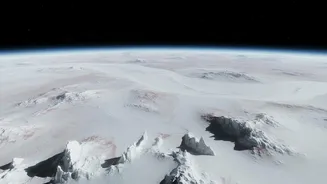
little more than a blurry dot in our most powerful telescopes. Suddenly, it was transformed into a complex and stunningly diverse planet, complete with towering mountains of water ice, vast nitrogen glaciers, and a surprisingly complex atmosphere. The initial images revealed a world that was anything but the geologically dead, crater-pocked sphere many had expected. Instead, features like the bright, heart-shaped basin named Sputnik Planitia showed a near-total lack of craters, suggesting its surface was geologically young and actively being renewed.
A Heart That Bleeds Nitrogen
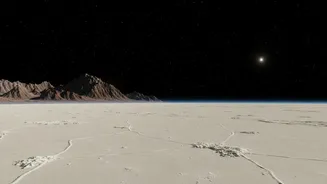
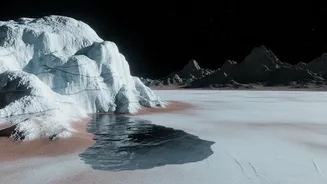
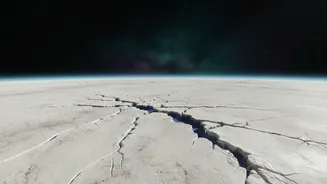
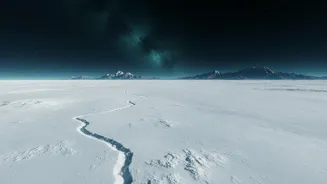
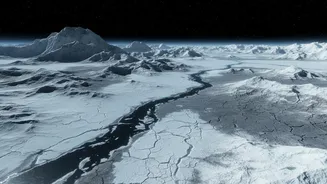
Now, more than a decade later, scientists have announced a startling new discovery from that very same data. A recent study, published in the Planetary Science Journal, provides the first strong evidence of recently flowing liquid on Pluto's surface. By re-analyzing high-resolution images of Sputnik Planitia, researchers identified dark streaks and patches along the glacier's northern edge. These features strongly resemble patterns seen on Earth where liquid has welled up from beneath a glacier and wetted the surface. But on Pluto, where surface temperatures hover around minus 230 degrees Celsius, the liquid isn't water. The team concluded that the only plausible explanation is liquid nitrogen, periodically seeping up from beneath the massive ice sheet through cracks and fractures.
Digital Archaeology in Deep Space
How is it possible to find something so significant in data that has been studied for years? The answer lies in a form of 'digital archaeology'. As our analytical tools and understanding of planetary processes improve, scientists can revisit old datasets and see them with new eyes. In this case, the team combined advanced image processing with insights from terrestrial glaciology. The initial flyby was a frantic, hours-long event that collected an enormous amount of information, which took over a year just to transmit back to Earth. The first wave of analysis focused on the biggest discoveries. Now, researchers are engaged in more detailed, painstaking work, teasing out subtle clues that were missed in the initial rush. It's a testament to the fact that a mission's value doesn't end with the flyby; the data archive itself is a treasure chest that can yield discoveries for decades.
A World More Alive Than We Knew
This discovery fundamentally changes our perception of Pluto. The idea that a world so far from the Sun could harbour enough internal heat to maintain liquids—even liquid nitrogen—just below its surface is revolutionary. It suggests Pluto is not a frozen, static relic from the solar system's formation but a dynamic and evolving body. The presence of liquid nitrogen welling up implies a form of active 'plumbing' beneath the ice, a process that could be happening even today on geological timescales. This finding, along with other recent analyses identifying potential supervolcanoes and ancient landslides, paints a picture of a surprisingly active world. It forces us to reconsider the conditions under which planets can remain geologically active, expanding the possibilities for other distant, icy bodies in the Kuiper Belt and beyond.