



A Journey from Plains to Peaks
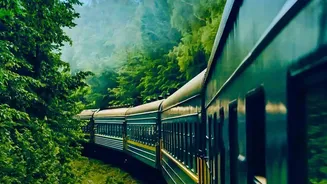
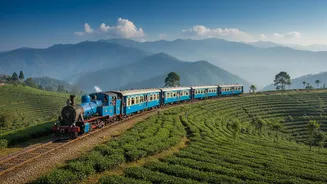
The adventure begins at Mettupalayam, a town nestled at the foot of the Nilgiri mountains. As passengers board the iconic blue and cream coaches, there is a palpable sense of excitement. In this initial stretch, the train moves at a familiar pace, crossing
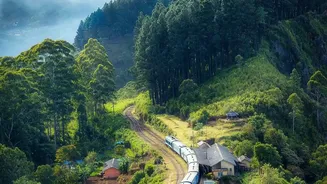
the serene Bhavani River and winding through flatlands. But soon, the landscape begins to change dramatically. The gentle plains give way to dense forests and the air grows cooler. The train is approaching its first great challenge at Kallar station, the point where the real climb begins and where ordinary railway physics simply will not suffice.
The Challenge: Asia's Steepest Slope
A conventional train relies on the friction, or adhesion, between its steel wheels and the steel rails. This works perfectly on flat ground and gentle slopes. The Nilgiri route, however, is anything but gentle. It boasts the steepest railway gradient in all of Asia, with inclines as sharp as 1-in-12. This means that for every 12 metres the train moves forward, it climbs one metre higher. On a slope this severe, a normal train's wheels would just spin helplessly, unable to grip the track. To conquer these Blue Mountains, the railway’s pioneering builders had to look beyond conventional engineering and adopt a technology from the Swiss Alps.
The Solution: A Railway with Teeth
The secret to the Nilgiri train's climbing prowess is a special third rail running between the two conventional rails. This is the 'rack', a solid steel bar with teeth cut into it, like a long, flat gear. The locomotive is fitted with a corresponding cogwheel, known as a 'pinion'. Just after Kallar station, passengers feel a distinct jolt and hear a loud 'clunk' as the pinion engages with the rack. The engine, which pushes the train from the back for better stability on the climb, now physically locks onto the track. It is no longer just rolling; it is mechanically pulling itself up the mountain, one tooth at a time. This is the Abt rack-and-pinion system, and it is the only one of its kind in India.
A Legacy of Swiss Engineering
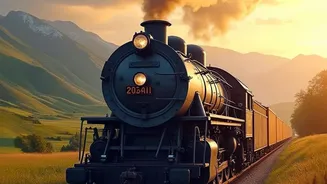
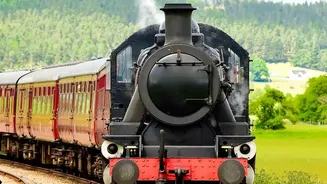
The construction of this railway was an epic saga that began with proposals in 1854 but only saw completion in 1908 due to the immense engineering challenges. The rack-and-pinion technology was not an afterthought but the core solution. To power this system, special 'X' Class steam locomotives were imported from the Swiss Locomotive and Machine Works company, a testament to Swiss expertise in mountain railways. Many of these original workhorses, now over eight decades old, still faithfully push carriages up the steep climb to Coonoor. The system is so effective that it has remained largely unchanged for over a century, a living, breathing museum of industrial heritage.
More Than a Ride, A World Heritage Experience
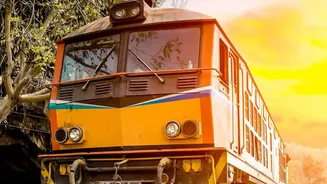
The rack system is used on the most demanding section, from Mettupalayam to Coonoor. From Coonoor, the gradient lessens, and the journey to Ooty (Udhagamandalam) continues on a conventional track, pulled by a diesel locomotive. But the entire 46-kilometre route is a spectacle. The train moves at a leisurely pace of about 10-13 km/h on the steep sections, giving travellers ample time to soak in the views of verdant tea plantations, cross over 250 bridges spanning deep gorges, and disappear into 16 hand-cut tunnels. In 2005, UNESCO recognised the Nilgiri Mountain Railway as a World Heritage Site, cementing its status not just as a mode of transport, but as a globally significant cultural and engineering treasure.