








An Ocean World Hiding in Plain Sight
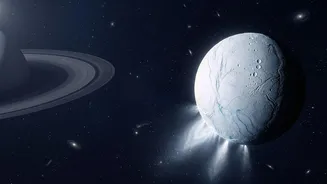
From a distance, Enceladus looks like just another frozen ball of ice. But beneath its thick, reflective crust lies its biggest secret: a global ocean of liquid saltwater. This wasn't just a guess; NASA's Cassini spacecraft flew directly through giant
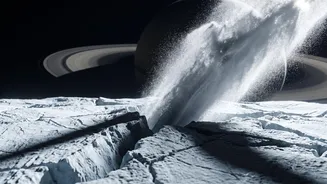
plumes of water vapor and ice erupting from cracks near the moon's south pole. These geysers, spewing material from the hidden ocean hundreds of kilometers into space, offer a unique opportunity. They allow scientists to sample an extraterrestrial ocean without ever having to drill through the ice. Analysis of this spray has already confirmed the presence of salts and organic compounds, key ingredients for life as we know it.
The Search for Life's Fingerprints
When scientists search for extraterrestrial life, they aren't necessarily looking for little green men. They're hunting for biosignatures—molecules or substances that provide evidence of past or present life. These can include complex organic molecules like amino acids, which are the building blocks of proteins. Previous data from Cassini had already found simple organics, but recent analyses have confirmed a richer, more diverse collection of compounds, including hydrogen cyanide, a crucial molecule for forming amino acids. The challenge, however, has always been whether these delicate molecules could survive the violent eruption into space and be detected by a passing spacecraft.
A Natural Sorting System for Evidence
This is where the latest research provides a major breakthrough. Two new studies published in September 2026 suggest that the process of ocean water freezing and erupting into space actually helps preserve and concentrate these potential biosignatures. Scientists from Freie Universität Berlin proposed that as water droplets travel up through cracks in the ice shell, they freeze more slowly than previously assumed. This slow freezing causes different components, like salts and organic molecules, to separate and become concentrated in different parts of the ice. When these super-fast droplets hit the walls of the ice cracks and shatter, the resulting fragments are highly concentrated bits of individual substances. This means a future mission might just need to find one of these 'pure' grains containing biological material to get a clear signal, making detection far easier.
Habitable, But Not Yet Inhabited
This is a crucial distinction that sits at the heart of the Enceladus story. Discovering water, organic molecules, and a source of energy—which Enceladus has, thanks to hydrothermal vents on its seafloor—means the moon is 'habitable'. It has all the ingredients in the pantry needed to support life. One of the recent studies even showed that methane-producing microbes from Earth could survive in simulated Enceladus ocean conditions. However, having a well-stocked kitchen doesn't automatically mean someone is home cooking a meal. As of now, we have found compelling evidence that life could exist on Enceladus, but zero direct proof that it does. The new findings make the moon a more compelling target, but they are not proof of life itself.
What Comes Next in the Search?
These discoveries essentially provide a better roadmap for how to search for life on Enceladus. They tell scientists that analyzing individual ice grains, rather than the plume as a whole, is the most promising strategy. This will heavily influence the design of future missions currently in the planning stages. Proposals like NASA's Enceladus Orbilander are being designed to orbit the moon, fly through its plumes multiple times to collect samples, and eventually land on the surface to conduct a detailed search for life. While such a mission is still years away, the latest findings ensure that when we do go back, we will know exactly what to look for and how to find it, dramatically increasing our chances of finally answering one of humanity's greatest questions.