


A Galaxy Knocked Sideways
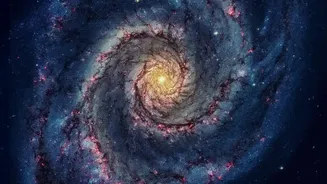
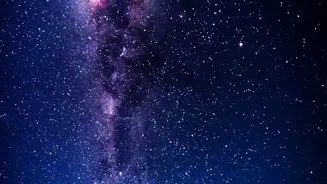
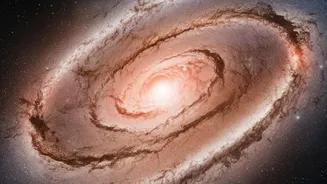
Imagine a spinning top getting knocked by a marble. Over a cosmic timescale, something similar may have happened to the Milky Way. When scientists say our galaxy was “flipped,” they mean the vast, flat, spinning disc of stars where our solar system resides
was tilted by more than 90 degrees. This wasn't an instantaneous event but a gradual reorientation over hundreds of millions of years. The theory comes from new research presented at the Royal Astronomical Society's National Astronomy Meeting, which used supercomputer simulations to explain a long-standing cosmic puzzle. For years, astronomers were baffled by the behaviour of the Milky Way’s “stellar halo”—a sparse, spherical cloud of ancient stars that surrounds the main galactic disc. While stars in the disc (like our Sun) orbit the galactic centre at a brisk 220 kilometres per second, the stars in the halo barely seem to be moving, clocking in at a sluggish 10 to 25 kilometres per second. This new research suggests the flip is the missing piece of the puzzle.
The Prime Suspect: The 'Sausage' Galaxy
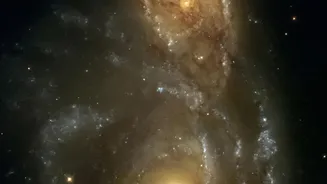
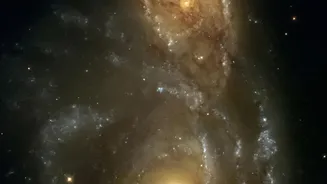
The culprit behind this galactic upheaval is thought to be a dwarf galaxy that astronomers have whimsically named Gaia-Sausage-Enceladus, or the 'Sausage' galaxy for short. The name comes from the elongated, sausage-like orbits of the stars it left behind after a catastrophic collision with our own galaxy. This wasn't a minor fender-bender; it was a head-on impact that occurred roughly 10 billion years ago, long before our Sun and Earth were formed. The Milky Way, being the much larger galaxy, tore the intruder apart and absorbed its stars and gas. But the collision was so powerful that the gravitational forces it unleashed were enough to slowly but surely exert a torque on our galaxy, causing the entire disc to tip over. According to Kirill Batrakov, the lead researcher from Durham University, this event was the most significant merger in the Milky Way’s early history and fundamentally reshaped it.
Following the Digital Breadcrumbs
Since we can’t travel back 10 billion years to witness the crash, scientists turned to the next best thing: powerful supercomputer simulations. The Durham University team analysed the evolution of 25 virtual galaxies similar to our own, using a program known as the Auriga simulations. They watched how these digital galaxies grew, collided, and changed over billions of years. A clear pattern emerged: the simulated galaxies that ended up with a slow-rotating stellar halo, just like the one observed in the real Milky Way, almost always shared two key historical events. First, they had experienced a massive, head-on merger. Second, their disc had flipped by more than 90 degrees. The remarkable match between the simulations and the real-world observations from the European Space Agency's Gaia satellite provides compelling evidence that our galaxy’s violent past is responsible for its current, peculiar orientation.
A New History for Our Home
This discovery does more than just solve the mystery of the slow halo; it rewrites a key chapter of our galaxy’s biography. The collision with the Sausage galaxy wasn't just destructive; it was creative. The event is now believed to have helped create the Milky Way's central bulge—the dense hub of stars at its core—and contributed the majority of the stars in the vast stellar halo. It paints a picture of a galaxy that was forged in chaos and has been settling down ever since. The finding also has implications for our own place in the cosmos. It means that the path of our Sun through the galaxy has likely changed dramatically over its lifetime. The 'stable' spot we currently occupy might not have been our solar system's home for its entire existence. We are, in a sense, living in the aftermath of this ancient, galaxy-altering event, which set the stage for the formation of stars like our own Sun within the newly settled disc.