







The future of solar power just got a significant boost. Researchers have pushed a new kind of solar technology, known as tandem solar cells, past a major efficiency milestone, signaling a potential new era for clean energy generation.
What Are Tandem Solar Cells?
Think of a standard
solar panel as a single net trying to catch different types of fish. It’s great at catching one type but lets others slip through. A tandem solar cell is like stacking two different nets. It combines a traditional silicon cell with a layer of another material, most promisingly a synthetic crystal called perovskite. The top perovskite layer is excellent at capturing high-energy blue light, while the silicon layer below captures the lower-energy red and infrared light that passes through. This layered, or “tandem,” approach allows the cell to harvest a much wider spectrum of sunlight and convert it into electricity, smashing through the efficiency limits of silicon alone.
Why the 30% Milestone Is a Game-Changer
For decades, the efficiency of commercial solar panels—how much sunlight they convert into electricity—has been improving steadily but slowly. Most panels installed on rooftops today operate in the 21-23% efficiency range. The theoretical maximum for a standard silicon cell, known as the Shockley-Queisser limit, is about 33.7%. Recent breakthroughs have seen lab-tested tandem cells officially certified at efficiencies well over 30%, with some records reaching as high as 35.5%. Crossing the 30% barrier is a massive psychological and technical achievement. It proves that tandem technology isn't just an incremental improvement; it's a revolutionary leap that fundamentally raises the ceiling for solar power generation.
The Importance of 'Commercial-Size Wafers'
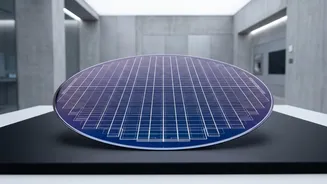
Achieving high efficiency in a tiny, microscopic cell in a pristine lab is one thing. Replicating that success on a larger piece of silicon, known as a wafer, is a completely different and far more important challenge. Recent milestones are significant because they have been achieved on commercial-grade wafers, the building blocks of the solar panels you see in the real world. This demonstrates that the technology is not just a scientific curiosity but has a viable path toward mass production. Companies have successfully created mini-modules and demonstrated scalable manufacturing processes, which is the bridge from the laboratory to the factory floor. This focus on size and scalability is what gives the latest efficiency records their commercial weight.
The Perovskite and Silicon Partnership
The magic behind these new records is the pairing of perovskite and silicon. Perovskites are a class of materials that are cheap to produce and incredibly effective at absorbing light. Their key advantage is a tunable bandgap, meaning scientists can engineer them to capture specific parts of the light spectrum that silicon isn't good at. When an ultra-thin, nearly transparent layer of perovskite is added to a silicon cell, it creates a powerful synergy. This combination has become the leading approach for next-generation solar cells, with a theoretical efficiency limit that could exceed 43%, far beyond what silicon can do on its own.
Hurdles on the Road to Your Rooftop
While the future is bright, tandem solar panels won't be available at your local installer tomorrow. The biggest remaining challenge is long-term durability. Perovskite materials can be sensitive to moisture and heat, and researchers are working to ensure these new cells can last for 25-30 years in harsh outdoor conditions, just like current panels. Another hurdle is scaling up manufacturing to reduce costs. While the materials are inexpensive, the processes for creating stable, large-area tandem modules are still being perfected. As of late 2026, tandem cells are not yet in mass commercial production, but multiple companies and research institutes are racing to be the first to bring them to market.