





The Moon’s Navigation Problem
On Earth, we take satellite navigation for granted. Your phone’s GPS can pinpoint your location within metres, thanks to a constellation of satellites orbiting our planet. The Moon, however, has no such infrastructure. For decades, lunar missions have
relied on constant communication with Earth-based tracking stations to navigate. This method is slow, requires a direct line of sight to Earth, and creates a significant bottleneck, limiting the speed and scope of exploration. Every move a rover makes has to be painstakingly managed by human operators thousands of kilometres away. For the ambitious goals of the Artemis program, which aims to establish a long-term human presence on the Moon, this old method simply won’t scale. A new approach is needed to unlock true lunar autonomy.
A Lunar 'GPS' in the Making
Enter NASA's innovative solution: a series of payloads designed to create a lunar navigation network. Instead of launching a costly new satellite constellation around the Moon, NASA is ingeniously repurposing signals that are already flying through space. Payloads like the Lunar GNSS Receiver Experiment (LuGRE) are designed with highly sensitive receivers capable of detecting faint signals from Earth's own Global Navigation Satellite System (GNSS), which includes the familiar GPS network. These signals, though weak at a distance of nearly 400,000 kilometres, can be used by a spacecraft or rover to calculate its position autonomously, without needing to “phone home” to Earth for directions. This forms the basis of a system that could one day function much like GPS does for us.
Putting the Technology to the Test
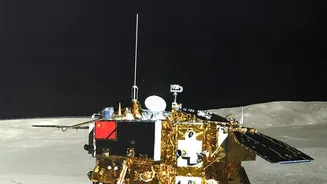
This groundbreaking technology is not just theoretical; it's actively being tested on the Moon. NASA is leveraging its Commercial Lunar Payload Services (CLPS) initiative, which partners with private companies to deliver science and technology to the lunar surface. A demonstrator called the Lunar Node 1 (LN-1) was successfully tested, proving that an autonomous navigation system could provide positioning data for explorers on the surface. More advanced payloads are following. For instance, a compact receiver called NavCube3-mini has been delivered for integration onto a lunar communications relay satellite scheduled for a late 2026 launch. This device is designed to track weak signals from both the US GPS and European Galileo constellations, demonstrating real-time navigation in the lunar environment.
Unleashing Autonomous Rovers
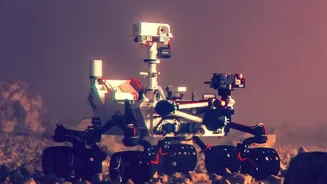
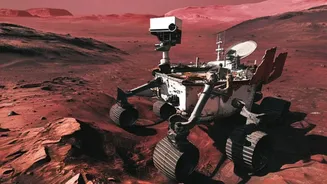
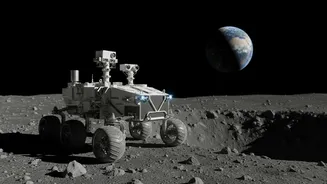
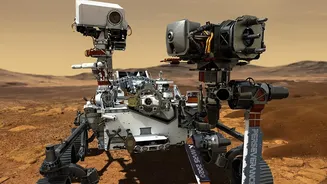
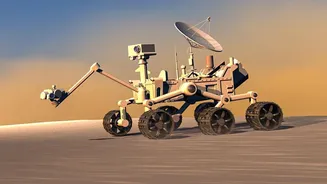
The most immediate beneficiaries of this technology will be the next generation of lunar rovers. A prime example is NASA's Cooperative Autonomous Distributed Robotic Exploration (CADRE) mission, slated to land on the Moon in 2026. This mission will deploy a team of three shoebox-sized rovers that will explore the lunar surface autonomously. Instead of receiving step-by-step commands, the rovers will get a high-level objective and then work together, electing a "leader" and making their own decisions about how to achieve the goal. This level of autonomy is only possible with reliable, independent navigation. By knowing their exact position, the rovers can coordinate to create 3D maps of the terrain and subsurface, gathering scientific data that would be impossible for a single, human-controlled rover to collect.
The Bigger Picture for Artemis
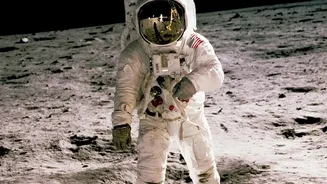
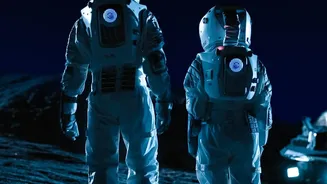
Reliable lunar navigation is a cornerstone of NASA’s long-term vision for the Moon. The Artemis program isn't just about planting a flag; it's about building a sustainable outpost for science and exploration. Autonomous navigation is critical for the Lunar Terrain Vehicle (LTV), a future vehicle that will transport astronauts farther across the lunar surface than ever before. This system will also allow the LTV to operate remotely between crewed missions, transporting cargo and conducting science. Ultimately, establishing a lunar navigation network will support everything from landers and rovers to the astronauts themselves, making operations safer, more efficient, and laying the essential groundwork for future human missions to Mars.