

A Galaxy Askew
For years, a subtle cosmic mystery has puzzled astronomers. Beyond the familiar, flat disc of the Milky Way where our solar system resides, there is a vast, sparse sphere of ancient stars called the stellar halo. Data from the European Space Agency's
Gaia mission revealed something strange: while the stars in our disc zip around the galactic centre at over 200 kilometres per second, the stars in the halo barely seem to move, rotating at a comparatively sluggish pace. This discrepancy suggested that the halo and the disc are not perfectly aligned; they exist on a tilt relative to each other. This misalignment is a ghostly echo of a cataclysmic event from our galaxy's distant past.
The Prime Suspect: A Sausage-Shaped Galaxy
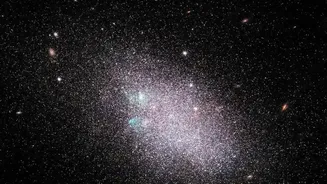
The culprit is thought to be a dwarf galaxy that astronomers have nicknamed Gaia-Sausage-Enceladus (GSE). This now-defunct galaxy slammed head-on into a young Milky Way between 8 and 11 billion years ago, long before the Sun and Earth formed. It was the last major merger in our galaxy's history, an event so significant it fundamentally reshaped our cosmic home. The name comes from the Gaia satellite, which first uncovered evidence of the merger, and the distinctive sausage-like shape of the orbits of the invading stars as plotted by astronomers. Though smaller than the Milky Way, the GSE was massive enough to deliver a body blow that would alter our galaxy's destiny forever.
Cosmic Detective Work
Uncovering an 11-billion-year-old collision is a monumental feat of cosmic detective work. Astronomers can't rewind time, so they rely on powerful computer simulations and the incredible precision of the Gaia space observatory. Gaia meticulously maps the positions, movements, and chemical compositions of billions of stars. Researchers noticed a population of stars within our halo moving on highly unusual, elongated orbits, plunging close to the galactic centre. These were the remnants of the GSE, their paths a tell-tale sign of a violent, head-on collision. By running simulations of galaxy mergers, astronomers at Durham University found that a head-on collision like the one with GSE was the most likely explanation for the halo's slow rotation and, remarkably, could have caused the entire galactic disc to slowly flip by more than 90 degrees.
A Violent, Galaxy-Bending Crash
This was no quick smash-up. The process of the Milky Way's disc reorienting itself likely took hundreds of millions, or even a couple of billion, years. The immense gravitational forces from the merger tore the GSE to shreds, scattering its stars throughout the Milky Way's halo. The impact also sent shockwaves through our young galaxy, puffing up the disc and triggering a massive burst of star formation. According to simulations, this powerful collision exerted a torque on the Milky Way's disc, gradually tipping its axis of rotation. The disc didn't flip like a coin but slowly tilted and resettled into a new orientation, while the stellar halo, composed of debris from the merger, retained a memory of the original impact angle. This explains why the disc and halo seem so misaligned today.
The Crash That Shaped Our Home
This ancient crash was not just a destructive event; it was a formative one. The debris from the Gaia-Sausage-Enceladus galaxy is now a major component of our Milky Way's inner bulge and stellar halo. The merger delivered fresh gas that fuelled the birth of new stars and may have even catalysed the transition from the galaxy's early, thick disc to the thinner disc we see today. Understanding this event helps us piece together the turbulent history of our galaxy. It shows that galaxies are not static islands but are constantly evolving through violent mergers and acquisitions. The fact that the Milky Way's disc survived at all suggests the GSE was large enough to do damage but not big enough to completely shatter it.