


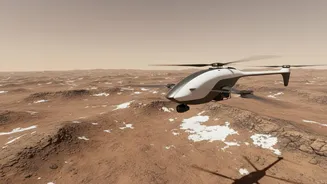

Meet Skyfall: A New Breed of Martian Explorer
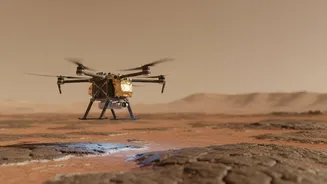
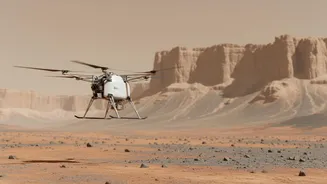
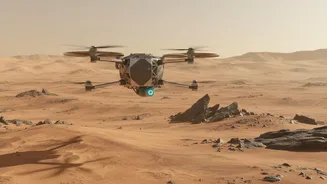
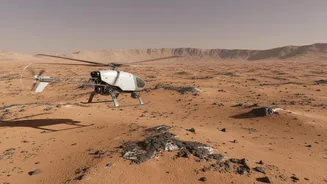
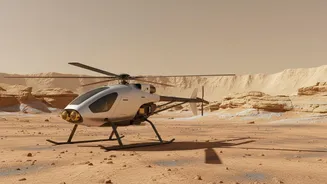
The Skyfall concept represents a major leap from a technology demonstration to a dedicated scientific mission. While Ingenuity proved that powered flight in Mars's thin atmosphere was possible, Skyfall is designed to be a workhorse. The mission concept involves
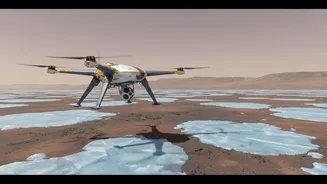
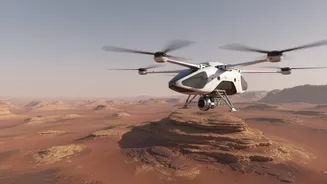
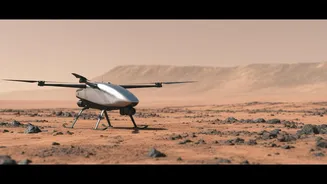
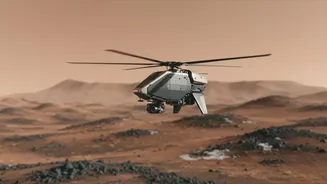
a trio of helicopters, evolved from the Ingenuity design but significantly more capable. Unlike Ingenuity, which was deployed from the Perseverance rover, the Skyfall helicopters would be released mid-air during the spacecraft's descent in a maneuver that gives the mission its name. This bold deployment strategy eliminates the need for a costly lander and allows the helicopters to begin their mission independently, communicating directly back to Earth without a rover relay.
The High-Tech Hunt for Hidden Ice
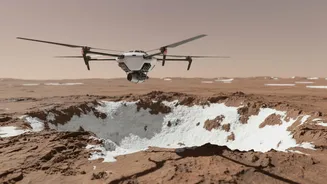
Skyfall's primary objective is to find buried water ice. Orbiting spacecraft have mapped vast ice deposits, but they can't see the crucial first few feet below the surface. This is the zone where ice might be accessible for future missions, and Skyfall is designed to fill that knowledge gap. To do this, each helicopter will be equipped with a suite of instruments, including ground-penetrating radar. A key innovation is the radar's antenna, a lightweight, flexible fabric that looks like a cape. This 'cape' unfurls during flight, allowing the helicopter to peer up to 16 feet below the ground as it flies low and slow, mapping the boundary between dry soil and hidden ice.
More Than Just an Ice-Finder
While finding ice is the main goal, the Skyfall helicopters are envisioned as multi-purpose scientific scouts. In addition to the radar, they would carry a suite of other instruments. This includes 13-megapixel color cameras to create detailed 3D terrain maps, which can be used to identify safe landing zones for future human-scale missions. Near-infrared cameras will analyze the composition of surface materials, and advanced sensors will measure weather patterns like temperature and wind speed. This gives them the ability to survey terrain that is too difficult or risky for a rover to access, offering a completely new perspective on Martian geology and climate history.
Why Ice Is the Ultimate Martian Prize
The search for water on Mars has been a guiding principle of NASA's exploration for decades. Subsurface ice is not just a scientific curiosity; it's the most critical resource for enabling a long-term human presence on the Red Planet. Accessible water ice could be harvested and processed to provide drinking water for astronauts. It can also be broken down into its component elements, hydrogen and oxygen. This provides breathable air for habitats and can be used to manufacture rocket propellant, potentially allowing future crews to refuel their spacecraft for the journey home. Scientifically, this ice holds clues about Mars's past climate and could preserve signs of ancient microbial life.
The Path from Concept to Reality
It's important to remember that Skyfall is currently a mission concept developed by NASA's Jet Propulsion Laboratory and its commercial partner, AeroVironment, not yet a fully funded mission. However, it builds on the proven success of Ingenuity and leverages mature technology. Recent tests on the flexible radar antenna have been successful, demonstrating its ability to withstand the pressures of landing and redeploy for flight. The concept, part of NASA's push for innovative ideas, is targeting a potential launch in 2028. If it moves forward, Skyfall would represent a pivotal shift in planetary exploration, trading ground-based rovers for a nimble, multi-point aerial survey team that could unlock Mars's secrets from above.