





An Encore for a Veteran Explorer
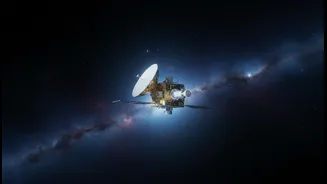
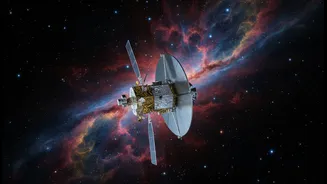
Launched in 2006, NASA's New Horizons spacecraft has already secured its place in history. Its 2015 flyby of Pluto transformed the distant, icy world from a blurry dot into a complex and beautiful landscape. Four years later, it visited Arrokoth, the most
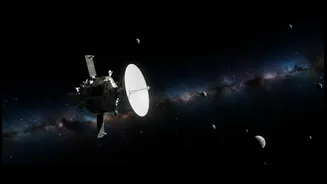
distant object ever explored by a spacecraft. But even as it speeds away from Earth at nearly 483 million kilometres per year, its mission may be getting a second act. In late June 2026, after a 321-day hibernation to save power, mission controllers confirmed the probe was awake and healthy, nearly 9.5 billion kilometres from home. Now, scientists are eagerly planning its next chapter: a journey to the heliosphere boundary, the invisible border where the Sun’s influence ends and interstellar space begins.
What Is the Heliosphere Boundary?
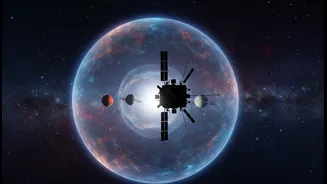
Think of the solar system as being inside a giant, protective bubble. This bubble, called the heliosphere, is created by the solar wind—a constant stream of charged particles flowing outward from the Sun. This bubble shields our planets from a significant amount of harsh galactic cosmic radiation. But this bubble doesn't go on forever. Far out in space, the solar wind eventually collides with the interstellar medium, which is the sparse collection of gas and dust that exists between star systems. The boundary where the pressure of the solar wind is no longer strong enough to push back against this interstellar material is called the heliopause. This is the true edge of the Sun's domain, a frontier only two other spacecraft, Voyager 1 and Voyager 2, have ever crossed.
A Unique Scientific Opportunity
While the Voyager probes were groundbreaking, they were launched in the 1970s. New Horizons carries a more modern and diverse set of scientific instruments. This gives it the unique ability to study the heliopause in ways its predecessors couldn't. For instance, some models predict that interstellar dust may pile up at this boundary, and New Horizons has a sophisticated dust counter to verify it. Its plasma and particle spectrometers can provide higher-fidelity data on how the solar wind behaves as it slows down and terminates. This data is crucial for understanding the shape and dynamics of our solar system's shield. New research suggests the spacecraft could reach this boundary, known as the termination shock, sometime between 2029 and 2040.
A Race Against Time and Power
The biggest challenge for this ambitious new goal is power. New Horizons is powered by a Radioisotope Thermoelectric Generator (RTG), which essentially uses the heat from decaying plutonium to generate electricity. The power output naturally decreases over time. Mission planners have become experts at conserving energy, putting the spacecraft into long hibernation periods to save its precious watts for scientific observations. Projections show that the probe could continue to operate its instruments into the 2030s, and potentially remain functional until it is 100 times farther from the Sun than Earth is. The mission team, led by Principal Investigator Alan Stern, must propose this extended mission to NASA to secure the funding needed to track the spacecraft and analyze the invaluable data it could send back from this unexplored region.