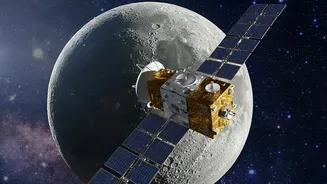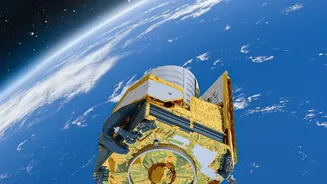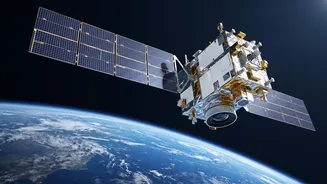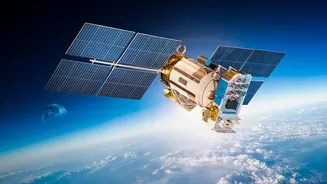






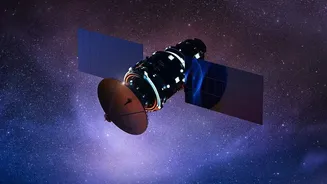


A Promise Finally Fulfilled
The story of EOS-05 is one of resilience. Its predecessor, EOS-03 (or GISAT-1), was lost in a launch anomaly in August 2021, creating a significant gap in India's strategic assets. That mission was designed to place a powerful imaging satellite into a geostationary
orbit (GEO) approximately 36,000 km above the Earth. Unlike satellites in low-Earth orbit (LEO) that pass over a location periodically, a GEO satellite remains fixed over one area, providing continuous, real-time monitoring. The failure was a major setback. Now, with the successful launch of EOS-05 (also known as GISAT-1A) aboard the GSLV-F17 rocket, ISRO has not only overcome past technical hurdles but has finally delivered on a long-held strategic goal. This success broke an eight-month launch hiatus for the agency, marking a crucial psychological and technical milestone.
The 'Unblinking Eye' Advantage
So, what makes a geostationary imaging satellite so important? The primary advantage is persistence. LEO satellites provide high-resolution images but have revisit gaps, meaning hours or even days can pass before they fly over the same spot again. For tracking rapidly developing events like cyclones, forest fires, or troop movements along a border, these gaps are a critical vulnerability. EOS-05 is designed to eliminate this weakness. It can provide images of a selected area every five minutes and scan the entire Indian landmass every half hour. This capability transforms disaster management, allowing for near-continuous tracking of weather systems and enabling faster response times for events like floods and cloudbursts. It provides an 'unblinking eye' over a vast area, a game-changer for both civilian and strategic applications.
The Next Phase: Strategic and Civilian Synthesis
The next phase for EOS-05 involves integrating its powerful data stream into India’s national infrastructure. For security, it provides unprecedented surveillance capabilities over borders and maritime zones, offering early detection of adversary movements. While it complements, rather than replaces, the high-resolution LEO satellites, its constant watch is a significant force multiplier. Beyond its strategic role, the satellite's applications are vast. Its multispectral and hyperspectral imaging capabilities will be invaluable for agriculture, helping to monitor crop health, and for forestry and mineralogy. This dual-use capability is the essence of its importance; it enhances national security while simultaneously driving economic and social development through better resource management and environmental monitoring.
A Foundation for Future Ambitions
The successful deployment of EOS-05 is more than just the addition of a single satellite; it represents the maturing of India's GSLV rocket program and its crucial indigenous cryogenic upper stage. After a string of setbacks, including two PSLV failures in 2025 and 2026, this success rebuilds momentum for ISRO. It demonstrates a renewed reliability in launching heavy, complex payloads to high orbits. This restored confidence is critical as ISRO plans more ambitious missions, including further satellites in the EOS series and the Gaganyaan human spaceflight program. The story of EOS-05, therefore, is not just about a single piece of hardware. It’s about the persistence of a strategic vision, the overcoming of failure, and the establishment of a robust capability that will serve India for years to come. The next chapter in India's space story now has a much stronger foundation.