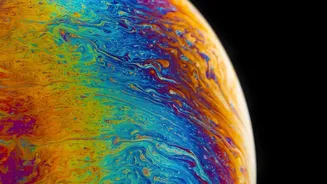




Have you ever watched a soap bubble drift through the air and marvelled at the swirls of colour on its surface? That magical, shimmering rainbow isn't dye—it's a spectacular display of physics at work, right before your very eyes.
More Than Soap and Water
To understand the colours,
we first need to understand the bubble itself. A soap bubble isn't just a puff of air; its wall is a sophisticated structure. It's an incredibly thin layer of water sandwiched between two even thinner layers of soap molecules. This structure is what scientists call a 'thin film'. The 'thin' part is crucial—the film's thickness is comparable to the wavelength of light itself, which is the secret to its colourful performance. Without this specific structure, the magic simply wouldn't happen.
The Journey of a Light Wave
When white light, which contains all the colours of the rainbow, hits the bubble, something fascinating occurs. The light beam splits. A portion of the light wave immediately reflects off the outer surface of the soap film. The rest of the light wave passes through the outer soap layer, through the water core, and then reflects off the inner surface of the film. Now, we have two separate light waves, both originating from the same source, but one has travelled a slightly longer path than the other.
A Tale of Two Waves
The magic of the colours comes from what happens when these two reflected light waves meet and recombine. This phenomenon is called interference. Think of it like ripples in a pond. If the peaks of two ripples meet, they create a bigger ripple. If a peak meets a trough, they cancel each other out. Light waves behave similarly. The two waves reflected from the bubble's surfaces interfere with each other before they reach your eye.
Constructive and Destructive Interference
When the reflected waves align perfectly (peak meets peak), they reinforce each other. This is called 'constructive interference', and it makes that specific colour of light appear bright and vibrant. When the waves are out of sync (peak meets trough), they cancel each other out. This is 'destructive interference', and it effectively removes that colour from the light you see. So, for any given spot on the bubble, some colours are being amplified while others are being erased.
Why So Many Swirling Colours?
The key is that the thickness of the soap film is not uniform. It's constantly changing. Gravity pulls the water downwards, making the bubble thinner at the top and thicker at the bottom. The distance the light has to travel through the film determines which colours will interfere constructively. A slightly thicker area might be perfect for amplifying blue light, while a slightly thinner area amplifies yellow or magenta. Because the bubble's thickness is constantly shifting and swirling, the bands of colour seem to dance and move across its surface.
Not Just for Bubbles
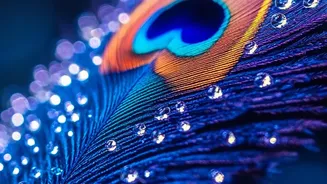
This beautiful effect, known more broadly as iridescence, isn't limited to soap bubbles. You can see the same physics at play in the rainbow sheen of an oil slick on wet pavement, the shimmering colours of a peacock's feather, the wings of many butterflies, and the lustrous inside of a seashell. In all these cases, microstructures or thin films are splitting light and causing waves to interfere, creating colour from structure rather than from pigment. It’s also used in technology, such as creating anti-reflective coatings for camera lenses and glasses.