





A Cosmic Powerhouse in Our Backyard
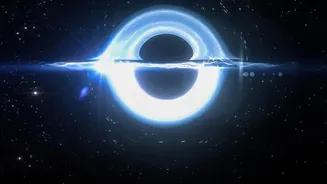
Astronomers have found what they believe is the strongest candidate yet for a 'microblazar' within our own Milky Way galaxy. The object, known as IRAS 18293-0941, is a binary system located approximately 12,000 light-years away. It consists of a black
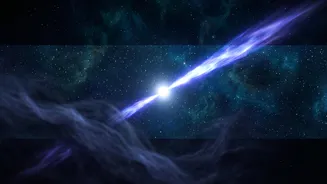
hole about 10 times the mass of our Sun that is actively pulling material from a massive companion star. As this material spirals into the black hole, it creates immensely powerful jets of particles and radiation that shoot out from the black hole's poles at a staggering 75% of the speed of light. What makes this system so special, and potentially a microblazar, is that one of these powerful jets appears to be pointed almost directly at Earth.
What Exactly Is a Microblazar?
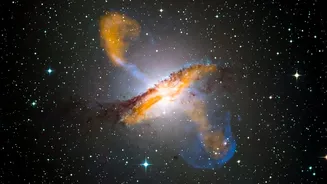
Think of a blazar as a cosmic lighthouse with its beam aimed right at you. They are some of the most energetic objects known in the universe, powered by supermassive black holes millions of times the mass of the Sun at the centers of distant galaxies. A microblazar works on the same principle but on a much smaller scale. Instead of a supermassive black hole, it involves a 'stellar-mass' black hole in a binary system with a companion star. The extreme gravity of the black hole strips gas from its companion, forming a superheated disc of material around it. Magnetic fields then channel some of this material into narrow jets that blast outwards at near-light speed. When one of these jets happens to be oriented towards Earth, the system appears incredibly bright due to an effect called relativistic beaming, earning it the 'microblazar' title.
The Challenge of Confirmation
While IRAS 18293-0941 is a promising candidate, the 'challenge' for astronomers is to definitively prove its microblazar status. For over three decades, scientists have theorized that these objects should exist in our galaxy, but finding a confirmed one has been elusive. This particular system was actually cataloged decades ago but was largely forgotten, hidden behind a thick shroud of interstellar dust that makes it invisible in ordinary optical light. To confirm its identity, researchers are using a global network of telescopes to observe it across many wavelengths, from radio to X-rays. They are looking for key signatures, like rapid variations in brightness, which are expected as the jet points our way. So far, these variations haven't been clearly detected, possibly because a cloud of gas around the system is smoothing them out.
A Laboratory for Extreme Physics
Confirming IRAS 18293-0941 as a microblazar would be more than just checking a box on a cosmic list. Because it's in our own galaxy, it would serve as a nearby natural laboratory for studying some of the most extreme processes in the universe. Blazars are too distant to resolve in detail, but a local version would give scientists a front-row seat to how these powerful jets are formed and behave. Furthermore, the jet that points away from Earth appears to be slamming into a dense molecular cloud. This collision is thought to create a massive particle accelerator, potentially 100 times more powerful than the Large Hadron Collider on Earth. This could help solve another long-standing mystery: the origin of some of the highest-energy cosmic rays detected in our galaxy.