

The Sun’s Lithium Puzzle
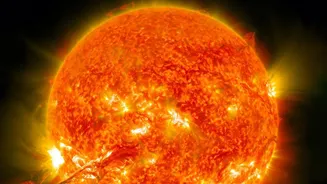
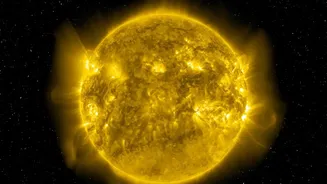
For decades, astronomers have been puzzled by the Sun's chemical composition. Specifically, it has a surprisingly low amount of the element lithium in its outer layers compared to other, similar stars. Based on its age and type, our star should have about
three times more lithium than it does. Lithium is a fragile element, easily destroyed by the high temperatures found deep inside a star. In stars like the Sun, material from the surface circulates downwards in a process called convection, but standard models suggest this process shouldn't be deep enough to burn off so much of the star's original lithium. This discrepancy, known as the "solar lithium problem," has been a persistent riddle, suggesting something unusual happened in our Sun's past.
A Missing Piece: The Super-Earth
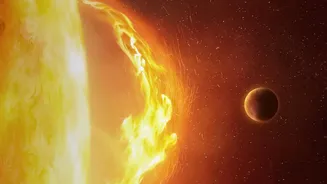
Our solar system is something of an oddity. While astronomers have discovered thousands of exoplanets, one of the most common types they find is the "super-Earth"—a rocky world up to 10 times the mass of our own planet. Yet, our own system has none. Previous research has suggested that super-Earths may have once formed here, perhaps in orbits even closer than Mercury's, before some unknown event cleared them out. This has led to a fascinating hypothesis: what if one of these lost worlds didn't just disappear, but was consumed by the Sun? This violent event could potentially account for both the missing super-Earths and the Sun's missing lithium.
A Planetary Sacrifice
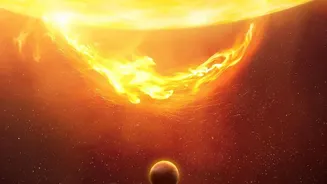
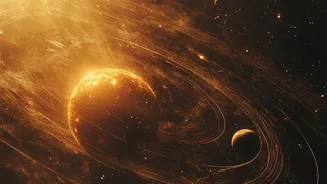
According to new research published in the Monthly Notices of the Royal Astronomical Society, the early solar system was a chaotic place. It's plausible that a super-Earth's orbit became unstable, causing it to spiral inward and plunge into the young Sun. Researchers from Ege University in Turkey used sophisticated computer models to simulate this very scenario. Their simulations showed that a planet between five and ten times the mass of Earth falling into the Sun would dramatically alter the star's internal dynamics. The massive impact would have created turbulence, effectively stirring the Sun's interior and dragging lithium from the surface down into the hotter core where it would be destroyed, leaving the lithium-depleted star we see today.
More Than Just Lithium
The planet-swallowing hypothesis doesn't just neatly solve the lithium problem. It also helps to resolve other subtle mismatches between standard solar models and what we observe through helioseismology—the study of sound waves moving through the Sun. These models have long struggled to perfectly align with the Sun's observed internal structure. By adding the engulfment of a super-Earth to the simulation, the researchers found that their model of the Sun became a much better match for the real thing. This suggests that such a cataclysmic event could have left a lasting physical imprint on our star's structure that persists billions of years later.
The All-Important Qualification
Here is the critical caveat to keep in mind: this is a theory based on computer modeling, not direct observation. Researchers have not found definitive proof of a lost world, but rather have shown that its existence offers a plausible explanation for several long-standing solar puzzles. While elegant, it remains one of several possible solutions. Other theories suggest that factors like enhanced early rotation or magnetic activity could have also contributed to the lithium depletion. The scientists behind the study are careful to note that their work provides a compelling scenario, but it is not yet a smoking gun. The chemical fingerprints of such an event would be deep inside the Sun, making them incredibly difficult to detect directly.