


Humanity's Farthest Emissary
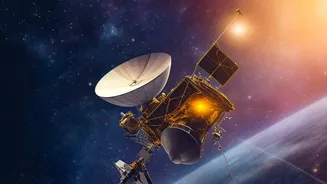
Launched in 1977, the twin Voyager probes were originally designed for a five-year mission to explore Jupiter and Saturn. Their success was so profound that the mission was extended, with Voyager 2 going on to visit Uranus and Neptune. But their greatest
chapter began after the planetary flybys were complete. In 2012, Voyager 1 became the first human-made object to enter interstellar space, the region between the stars. It is now over 25 billion kilometres from home, so far that a radio signal travelling at the speed of light takes a full day to reach it. This incredible distance makes the Voyager probes unique, acting as humanity's only direct outposts in the cosmic ocean beyond the protective bubble of our sun, the heliosphere.
The Inevitable Fading Light
The Voyager probes are too far from the sun to use solar panels for power. Instead, they rely on Radioisotope Thermoelectric Generators (RTGs), which convert heat from the natural radioactive decay of plutonium-238 into electricity. This system, with no moving parts, has proven remarkably durable. However, the plutonium's decay means the power supply is constantly diminishing. Each year, the probes lose about four watts of available power. Four watts might seem trivial, but for a spacecraft operating on a razor-thin energy margin billions of kilometres from a repair shop, it's the difference between collecting priceless data and falling silent forever. For years, engineers at NASA's Jet Propulsion Laboratory (JPL) have managed a careful 'power budget', strategically shutting down non-essential systems and heaters to keep the science alive.
The 'Big Bang' Solution
In a recent and ingenious move to prolong the mission, engineers executed a procedure nicknamed the 'Big Bang'. This wasn't a single fix but a carefully coordinated sequence of commands. The plan involved simultaneously turning off certain power-hungry devices and substituting them with lower-power alternatives. A key challenge was ensuring the spacecraft remained warm enough to operate in the extreme cold of interstellar space, where frozen fuel lines could permanently end the mission by preventing the probe from pointing its antenna toward Earth. For Voyager 2, this involved turning off two specialized heaters and an old digital tape recorder that was being used solely for its residual heat, then activating more energy-efficient heating elements. The daring manoeuvre, which required nearly two days just to confirm its success due to the immense signal delay, has bought the mission valuable time.
What Are We Still Learning?
Without this new power budget, mission managers would have been forced to shut down another of Voyager 2's science instruments before the end of 2026. Thanks to the 'Big Bang' fix, its three remaining active instruments are expected to continue operating for at least another year. A similar operation is planned for the more distant Voyager 1 in the coming months. The instruments still active on the probes, including magnetometers and plasma wave subsystems, are providing the only direct measurements of the interstellar medium. They sample the density of plasma, the strength and direction of cosmic magnetic fields, and the flow of galactic cosmic rays that our sun's heliosphere normally deflects. This data is invaluable, offering a glimpse into the environment our solar system moves through and cannot be obtained by any other means.
A Legacy of Ingenuity
The continued operation of the Voyager probes is a multi-generational testament to human ingenuity. A mission designed in the 1970s with less computing power than a modern smartphone continues to push the boundaries of exploration. The teams at NASA and JPL have become long-distance mechanics, sending software patches and creative commands across unthinkable distances to keep their aging explorers alive. Every watt saved is a victory, and each new packet of data is a message from the void. The probes also carry the Golden Record, a time capsule of Earth's sounds and images, intended for any civilization that might one day find it. While that remains a distant possibility, the more immediate legacy of Voyager is its inspiration—a story of reaching farther and learning to solve impossible problems along the way.