



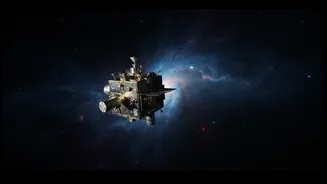


A Postcard from the Solar System's Edge
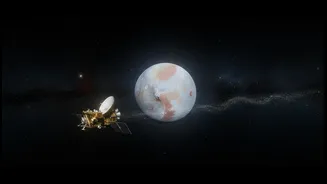
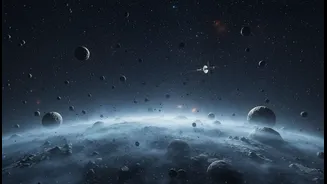
Remember New Horizons? It’s the intrepid NASA probe that gave us our first stunning, high-resolution look at Pluto back in 2015. After that historic flyby, it didn't stop. It continued its journey into the Kuiper Belt, a donut-shaped region of icy, rocky
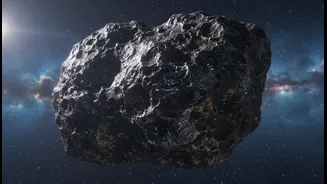
bodies left over from the formation of the solar system. This cosmic junkyard begins around the orbit of Neptune, about 30 times farther from the Sun than Earth is (a distance known as an astronomical unit, or AU). For years, scientists believed the densest part of this belt petered out around 50 AU. But as New Horizons cruises through this dark, cold expanse, now nearly 60 AU from home, it’s finding something that challenges that long-held belief.
Counting Cosmic Dust
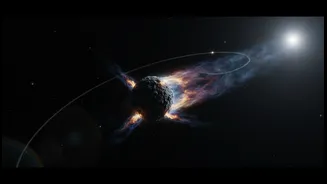
One of the key instruments aboard New Horizons is the Venetia Burney Student Dust Counter, or SDC. As its name suggests, it was designed and built by students, making it the first such instrument on a NASA planetary mission. Its job is simple but crucial: it counts the microscopic dust particles that pepper the spacecraft as it travels. This dust isn't just random debris; it’s the fine remnant of collisions between larger objects in the Kuiper Belt (known as KBOs), as well as particles kicked up from their surfaces by impacts from even tinier grains arriving from outside our solar system. By measuring the density of this dust, scientists can infer the presence of larger, unseen objects in the region. Think of it like walking through a forest at night; you might not see every tree, but the number of leaves you brush against tells you how dense the woods are.
An Unexpected Dust Storm
For years, scientific models predicted that as New Horizons traveled past 50 AU, the amount of dust it encountered would start to drop off, signaling the end of the main Kuiper Belt. But the SDC’s data, compiled over a three-year journey from 45 to 55 AU, shows the exact opposite. The instrument is detecting significantly higher levels of dust than expected. This isn't a small anomaly; it's a persistent finding suggesting that the source of the dust—a population of colliding KBOs—is still going strong far beyond where it was supposed to fade away. The readings are forcing a major rethink of the solar system's outer architecture.
A Second Belt or a Bigger One?
So, what does all this extra dust mean? The leading hypothesis is that the Kuiper Belt extends much farther than previously thought, perhaps as far out as 80 AU or even beyond. This idea is supported by recent ground-based observations from telescopes like Japan's Subaru Telescope, which have also spotted KBOs in this distant region. An alternative, and equally exciting, possibility is that there isn't just one continuous belt, but a second, entirely separate Kuiper Belt lying beyond the first one. As Alex Doner, the lead author of the study and a physics graduate student at the University of Colorado Boulder, put it, the findings offer a clue in solving the mysteries of the solar system's most distant regions. Either scenario—a single, sprawling belt or two distinct ones—would represent a fundamental discovery about our cosmic neighborhood.
Rewriting the Solar System Map
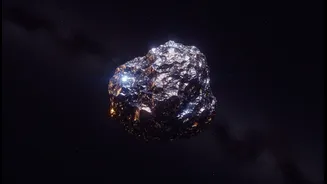
This discovery is more than just adding a new page to our astronomy textbooks. The size and structure of the Kuiper Belt are directly linked to the formation and evolution of our entire solar system. The objects within it are like frozen fossils, preserving the conditions of the early solar nebula from which the planets were born. A larger, more massive Kuiper Belt would change our understanding of how planets like Neptune migrated to their current orbits and how the outer solar system was structured. It suggests there was more material available in the early days than our current models account for. According to Alan Stern, the New Horizons principal investigator, this may be the first time a spacecraft has discovered a new population of bodies in our solar system.