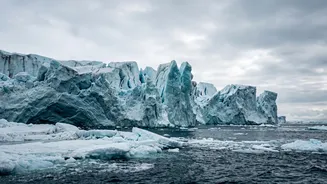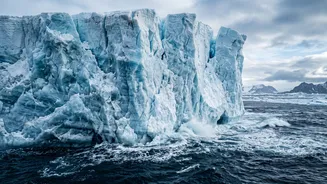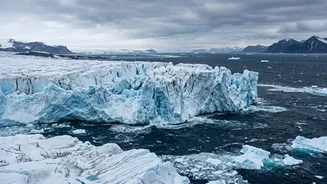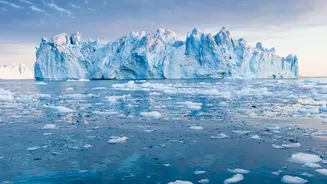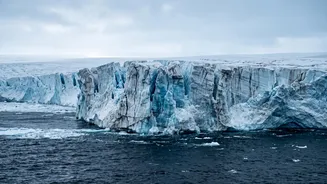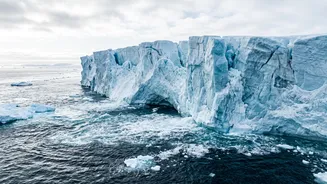






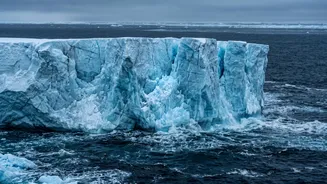
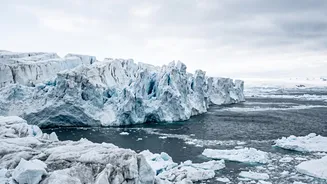
It’s nicknamed the ‘Doomsday Glacier’ for a reason. But new findings from Antarctica’s Thwaites Glacier reveal a process that makes its future even more uncertain, complicating how scientists predict its contribution to global sea-level rise.
The Doomsday Glacier Explained
Thwaites
Glacier, located in West Antarctica, is one of the largest and fastest-melting glaciers on Earth. Roughly the size of Great Britain, it has earned its ominous nickname because of the immense amount of ice it holds. If it were to collapse entirely, global sea levels could rise by over two feet. But its importance goes beyond its own volume. Thwaites acts as a natural dam, holding back the rest of the West Antarctic Ice Sheet. Its complete failure could eventually lead to a catastrophic 10-foot rise in sea levels, threatening coastal communities worldwide. For decades, scientists have tracked its retreat, noting that its melting already accounts for about 4% of current global sea-level rise.
A Hidden Threat: Seawater Intrusion
The latest research has uncovered a critical, previously underestimated process: large volumes of warm, salty ocean water are pushing miles under the base of the glacier. For years, models assumed the point where the ice meets the seafloor—the ‘grounding line’—was a relatively clear and stable boundary. However, new satellite data reveals this is not a line but a wide ‘grounding zone’, several kilometres across. With the daily rhythm of the tides, seawater is being pumped deep beneath the ice that is supposed to be firmly resting on bedrock. This tidal pumping allows ocean heat to attack the glacier from its underbelly, an area far inland from where this was thought to be happening.
Why This Complicates Predictions
This discovery of a wide, slushy grounding zone where seawater intrudes complicates the task of predicting ice loss. It helps explain a long-standing discrepancy where real-world satellite observations showed the glacier melting and accelerating faster than computer models predicted. By incorporating this new understanding of seawater intrusion, updated models now show that Thwaites could contribute up to 30 millimeters (1.2 inches) to sea-level rise by 2100—double the amount projected by previous models, even without any future increase in global warming. The complication isn't just that the melting is faster; it's that it's more variable and dynamic. Instead of a steady retreat, the process may be happening in pulses, weakening the glacier's connection to stabilizing underwater ridges that slow its flow.
Losing Its Grip on the Seafloor
The flow of Thwaites is currently held back by underwater mountains or ridges that act as anchors, pinning the glacier to the seafloor. The newly discovered seawater intrusion is weakening this connection, particularly at a formation known as the Mouginot Ridge. Scientists now estimate there is a 60% chance that the glacier will become completely 'unpinned' from this crucial ridge before the end of the century. Once it loses that anchor, its retreat could accelerate significantly as the bedrock behind the ridge slopes downward, exposing even more ice to the warming ocean. Past evidence shows the glacier is capable of retreating at twice its current speed when it loses contact with such a ridge.
The View from India's Coastline
For India, with its extensive 7,500-kilometre coastline and densely populated coastal cities like Mumbai, Chennai, and Kolkata, the fate of a faraway glacier is a direct concern. A 30-millimeter rise from a single glacier may not sound like much, but it magnifies the impact of every storm surge and high tide. Global sea level rise doesn't happen uniformly; it exacerbates existing coastal erosion, saltwater contamination of freshwater sources, and the risk of flooding. Understanding the revised, more aggressive melt scenarios for Thwaites is crucial for national and local governments to plan longterm coastal defence strategies and manage the risks for millions of people living in lowlying areas.