

A Celestial Crowded House
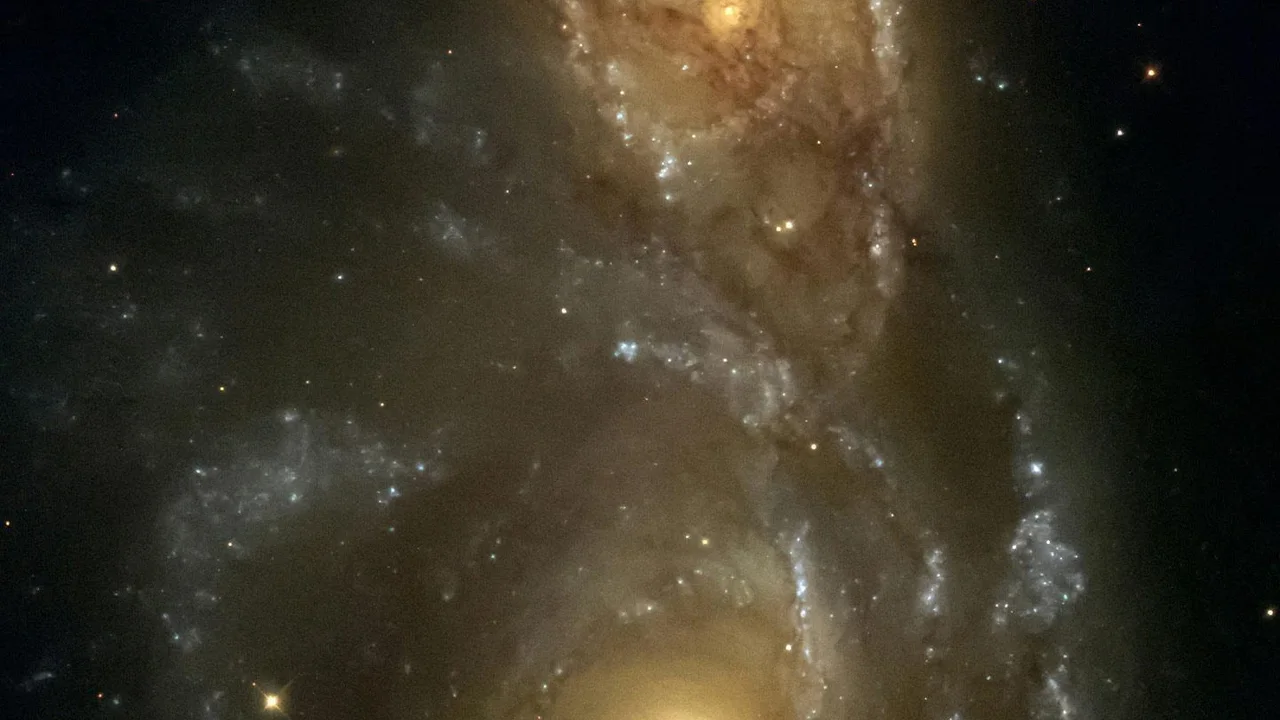
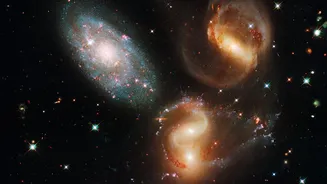
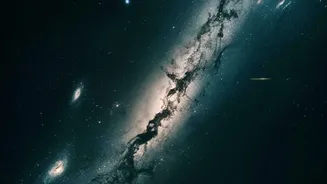
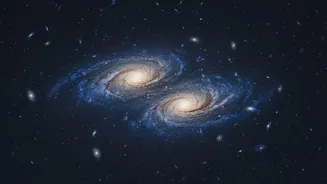
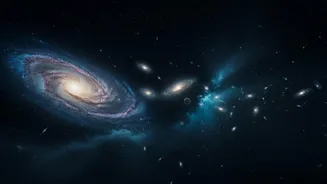
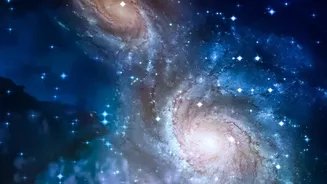
At first glance, the image is a spectacular snapshot of galactic interaction. It features what appear to be six galaxies, grouped into three distinct pairs, all seemingly caught in the act of merging. One pair seems to be in the early stages of a gravitational
hug, another looks like it could be a high-speed flyby, and a third appears to be a chaotic, active merger. This cosmic collection, located within the Centaurus Galaxy Cluster, presents a busy and dramatic scene. The vibrant streams of stars and distorted spiral arms suggest powerful forces at play, pulling and reshaping these immense star cities. It's the kind of image that captures the dynamic and violent beauty of the universe, a process that unfolds over millions of years but is frozen in this single frame.
The Deception of a Flat Sky
However, in astronomy, what you see isn't always what you get. The sky, as we view it, is a two-dimensional projection of a three-dimensional universe. Two objects can appear right next to each other, but one might be millions of light-years behind the other. This is known as a line-of-sight illusion. Think of it like a photograph where a person in the foreground appears to be holding the distant moon in their hand. We know they aren't actually touching, but the perspective creates a convincing, yet false, connection. Astronomers constantly grapple with this challenge. Is that pair of galaxies truly interacting, or is it just a chance alignment from our viewpoint on Earth? Answering that question is fundamental to understanding how galaxies evolve.
Untangling the Galactic Pairs
This specific image of three pairs provides a perfect case study. Detailed analysis reveals a more complex story than the initial view suggests. The bottom pair, identified as NGC 4622A and NGC 4622B, are indeed actively interacting and will likely merge into a single, larger galaxy over the next billion years or so. However, the middle pair is probably a trick of perspective. While they look close, measurements of their relative speeds suggest they are not gravitationally bound and are unlikely to be interacting. The top pair is the most complex; the galaxy with the distinct blue stripe is a rare polar ring galaxy, which itself was likely formed by a past collision, but it may not be currently interacting with its apparent neighbour. Each pair tells a different story: one of true interaction, one of chance alignment, and one of a complicated history.
The Science of Seeing Through Illusions
So, how do astronomers tell the difference? They have a toolkit of sophisticated techniques. The most crucial tool is measuring a galaxy's redshift. As the universe expands, distant objects are carried away from us, stretching their light towards the red end of the spectrum. By measuring this shift, astronomers can calculate a galaxy's distance with remarkable precision. If two galaxies that appear close together in an image have vastly different redshifts, scientists know they are actually separated by immense distances and not physically interacting. They also study the velocities and distribution of stars and gas, looking for tell-tale signs of gravitational disturbance, like streams of material being pulled from one galaxy to another, which are hallmarks of a true merger.