



Meet PUFFINS: Big Science in a Small Box
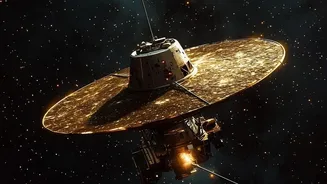
PUFFINS is a small satellite mission with a very specific, and important, job. The name stands for 'Polarimetry in the Ultraviolet to Find Features in INterStellar dust'. Selected as part of NASA's Astrophysics Pioneers program, which champions smaller,
cost-effective missions, PUFFINS is designed to deliver high-impact science without the price tag of a giant observatory. The mission, led by the University of Arizona, will use a compact satellite carrying a 10-inch telescope. Its goal is to study the smallest, most elusive grains of dust that drift through our galaxy. This initiative represents a new way of doing space science, proving that sometimes the most profound discoveries can come in small packages.
Why Interstellar Dust Matters
It might not sound glamorous, but interstellar dust is one of the most vital components of the cosmos. This 'dust' is made of tiny solid particles, mostly silicates and carbon, floating in the space between stars. Though it makes up only about one percent of the interstellar medium's mass, it plays a massive role in the lifecycle of the galaxy. These grains are the seeds from which stars and planets grow. They also affect how starlight travels, provide surfaces for cosmic chemical reactions to occur, and help regulate the temperature of gas clouds. By studying this dust, scientists can learn about the formation of our own solar system and the potential for life-birthing planets elsewhere in the universe.
A New Way to See the Dust
PUFFINS will focus on dust grains smaller than 50 nanometres, which are nearly impossible to study with conventional telescopes. To do this, it will revive a technique called ultraviolet (UV) spectropolarimetry from space, which hasn't been used for this purpose in nearly three decades. As light from distant stars travels through clouds of dust, its properties change. Specifically, the light becomes polarized, meaning its waves start to vibrate in a preferred direction. This happens because elongated dust grains tend to align with the galaxy's magnetic field. By measuring this polarization in the UV spectrum, PUFFINS can deduce the size, composition, and structure of these tiny particles, information that is otherwise hidden from view. The mission will observe roughly 70 stars in different cosmic environments to build a comprehensive map of this dust.
A Pioneer with an Indian Connection
The mission is particularly notable for its leadership. Bengaluru-born astronomer Dr. Ramya Anche, an assistant research professor at the University of Arizona's Steward Observatory, is the mission's Principal Investigator. Her selection to lead the $20 million NASA project marks a significant achievement and highlights the global and collaborative nature of modern space exploration. The PUFFINS mission is a joint effort between the University of Arizona and the McDonald Observatory, among others, and brings together a diverse team of researchers to tackle some of astronomy's long-standing questions. Targeted for launch in 2030, PUFFINS is not just about the science it will produce; it's also about training the next generation of scientists and engineers in developing focused, high-impact space missions.