






A World Forged by Gravity
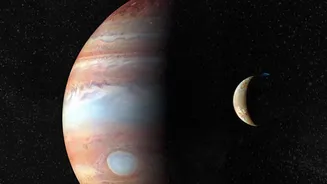
Io is a world perpetually tormented by its massive parent planet, Jupiter. The gas giant's immense gravity, along with the gravitational pull of neighboring moons, constantly stretches and squeezes Io in a process called tidal heating. This relentless
kneading generates enormous amounts of internal heat, fueling hundreds of volcanoes that spew gas and lava across its sulfur-stained surface. For years, our understanding of this process was limited to what we could see on the surface with infrared instruments, which only measure temperature at the very top layer. We could see the hot lava, but the engine driving it all remained hidden deep below.
A New Kind of Vision
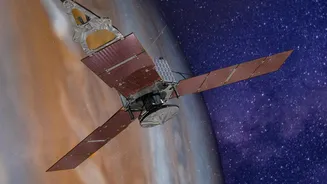
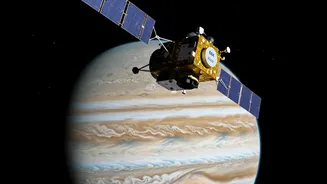
That all changed during two daringly close flybys in late 2023 and early 2024. NASA's Juno spacecraft, originally designed to study Jupiter's atmosphere, flew within 1,500 kilometers of Io's turbulent surface. Scientists repurposed one of its key instruments, the Microwave Radiometer (MWR), for a new task: to peer beneath Io's rocky crust. The MWR can detect microwave radiation, which allows it to sense thermal energy not just on the surface, but at depths of several feet. It was an unexpected capability for an instrument built to probe gas clouds, but it provided the first-ever temperature profile of a rocky moon's subsurface.
A Surprisingly Warm Welcome
The data sent back by Juno was stunning. Scientists found that just a few feet below the surface, the temperature jumped by more than 40 degrees Fahrenheit. This steep temperature gradient was far greater than what sunlight alone could account for, confirming that immense heat is radiating from Io's interior almost everywhere. One of the most surprising discoveries was that the surface itself is remarkably smooth in many areas, more like a plain of pumice or fluffy volcanic ash than solid rock. This low-density material appears to be a poor insulator, allowing more heat to escape from the depths below.
Solving the Loki Patera Puzzle
The new data is also helping to solve long-standing mysteries about specific features, like Loki Patera, a massive 200-kilometer-long lava lake. Infrared observations showed waves of resurfacing that slowly sweep across the lake, but scientists weren't sure why. Juno's close-up images and data suggest Loki Patera isn't just a simple bowl of magma. Instead, it appears to be a complex system with islands anchored to the lake floor, which have remained in place for decades. The slow cooling rates and other thermal properties suggest a large volume of magma exists just beneath a porous crust, explaining its unique and complex behaviour.
Why This Discovery Matters
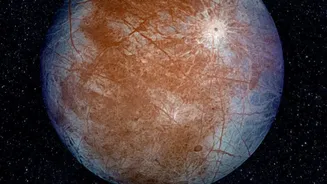
Understanding how heat moves through Io provides a unique window into a fundamental process that shapes worlds across the cosmos. Tidal heating is not only responsible for Io's volcanism, but it's also the engine that likely sustains the subsurface oceans on other moons like Europa and Ganymede. By studying this extreme example, scientists can build better models for how planetary bodies evolve. The techniques used by the Juno team could even have applications here on Earth. As Juno principal investigator Scott Bolton noted, using a similar microwave instrument to look beneath terrestrial volcanoes could reveal new information about how they work, potentially improving our ability to monitor them.