



A Galactic History Book
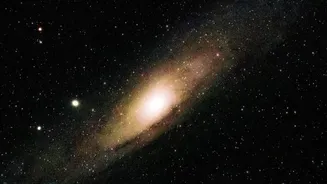
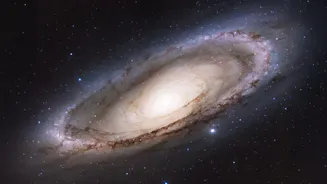
To understand how a galaxy evolves, you need to read its history. For Andromeda, that history is written in the stars. Astronomers have undertaken a massive project combining two extensive surveys by the Hubble Space Telescope: the Panchromatic Hubble Andromeda Treasury
(PHAT) and its southern counterpart, PHAST. Together, these programs have meticulously mapped roughly two-thirds of Andromeda's sprawling star-forming disk, cataloging an incredible 200 million individual stars. This isn't just about taking a pretty picture; it's a form of cosmic archaeology. Ben Williams, an astronomer at the University of Washington, notes that these individual stars act as a "fossil record" of the galaxy's past activity. Because Andromeda is relatively close at 2.5 million light-years, Hubble has the unique ability to resolve these individual points of light, a feat impossible for more distant galaxies.
Decoding Starlight
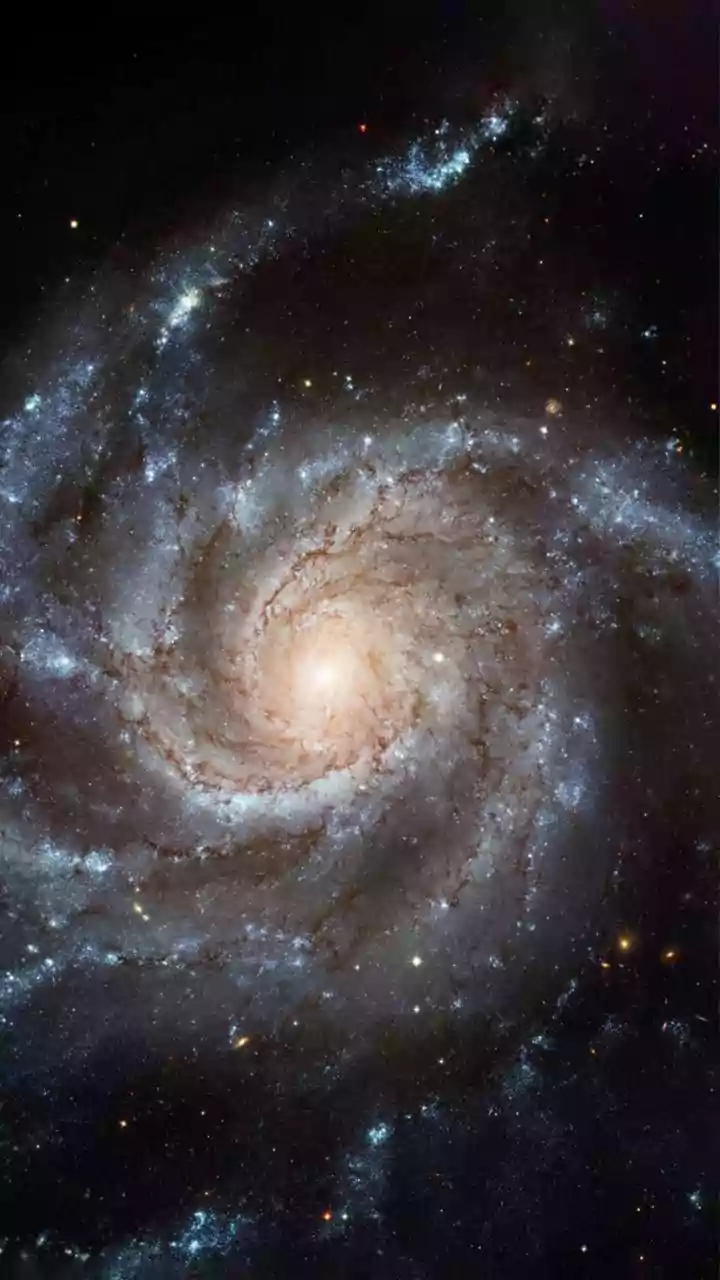
Reading the story of star birth involves looking for clues in the light. The key is knowing that not all stars are created equal. Massive stars burn through their fuel quickly, shining with a brilliant blue light before dying young, often within a few million years. Less massive stars, like our sun, are cooler, redder, and can live for billions of years. Therefore, areas of a galaxy gleaming with blue stars are cosmic nurseries where star formation has happened recently. Regions with a predominantly reddish glow are older and have settled down. To piece together Andromeda's timeline, scientists divided their vast map into thousands of smaller squares, each about 300 light-years across, and analyzed the color and brightness of the stars within each section to determine its star-formation history over time.
A Galaxy in Decline
The story Hubble tells is one of a galaxy that is slowly, but surely, winding down. The data reveals that Andromeda's rate of star birth has been on a steady decline for the last 500 million years. More dramatically, that slowdown has become even steeper in the last 40 million years. The numbers are striking: 500 million years ago, Andromeda was creating stars at a rate of about one solar mass (the mass of our sun) per year. By 40 million years ago, that rate had been cut in half. Today, it has plummeted to just one-fifth of a solar mass per year. This decline isn't uniform across the entire galaxy. Much of it is driven by fading activity in a prominent star-forming ring located about 32,000 light-years from the galactic center.
Taking a Breather
The slowdown isn't happening because Andromeda is running out of the gas and dust needed to make new stars. Instead, astronomers believe the galaxy is in a natural quiet period. This comes after a major burst of activity about two billion years ago, which is thought to have been triggered by a merger with another, smaller galaxy. That event created a huge wave of star formation, and the current decline appears to be the long, slow exhale after that cosmic exertion. Tobin Wainer, the study's lead author, poetically described it as taking a breather after running a marathon. This insight helps explain the life cycle of large spiral galaxies, showing they can move from active periods to quieter states.
A Case of a Cosmic Neighbor
Scientists are also investigating a potential instigator for some of the slowdown: Andromeda's small companion galaxy, M32. By examining the area of Andromeda's disk closest to M32, researchers found a localized drop in star formation that began around 60 million years ago. While the timing doesn't perfectly align with all theories of when M32 might have passed through Andromeda's disk, its proximity makes it a "likely suspect" for having a disruptive influence. It’s a cosmic whodunit that demonstrates the complex gravitational dances that shape galactic neighborhoods.