






The Fiery Ocean Below
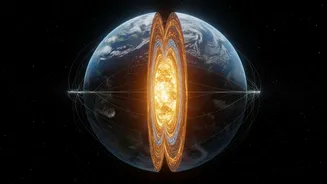
Imagine a world hidden more than 2,200 kilometres beneath the surface. This is Earth's outer core, a vast, turbulent ocean of liquid iron and nickel swirling around a solid inner core. Its immense heat and pressure make it completely inaccessible to any
direct exploration. For centuries, what happens in this deep realm has been a matter of complex theories and indirect observations. This moving sea of metal is not just a geological curiosity; it is the engine that powers a critical planetary system. By acting like a giant dynamo, the flow of liquid iron generates Earth's magnetic field.
Earth's Invisible Shield
The magnetic field is an invisible shield that protects us from harmful solar radiation and charged particles streaming from the sun. Without it, Earth's atmosphere could be stripped away, and our technological infrastructure, from power grids to navigation systems, would be highly vulnerable. Therefore, understanding the behaviour of the core is crucial. Scientists have long known the field is not static; it fluctuates and changes over time, influenced by the shifting currents of the molten core far below. Tracking these changes helps us forecast space weather and protect the technologies we rely on.
Listening from High Above
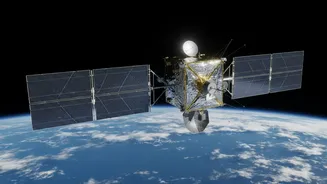
So how do you 'read' a process happening thousands of kilometres underground? You look for its signature from space. This is where missions like the European Space Agency's (ESA) Swarm satellites come in. Launched in 2013, this trio of identical satellites orbits Earth, carrying highly sensitive instruments called magnetometers. They measure the planet's magnetic field with exceptional precision. By flying in specific, coordinated orbits, they can distinguish between magnetic signals originating from the core, the crust, the oceans, and the atmosphere. This allows scientists to create detailed maps of the magnetic field and, by extension, infer the motion of the liquid iron that generates it.
A Surprising Reversal
For years, data suggested that the core's liquid iron flowed in a generally westward direction. But by analysing satellite and ground data, scientists discovered something startling. In 2010, a huge patch of molten material deep beneath the Pacific Ocean suddenly reversed course. What was a weak westward flow became a strong, fast-moving eastward current. This was a dramatic and unexpected event that challenged previous assumptions about the core being a relatively stable system. The reasons for this core-flow reversal are still a mystery, but its discovery has opened a new window into the turbulent dynamics of the deep Earth.
The Link to 'Geomagnetic Jerks'
This reversal may also help explain another geophysical puzzle: geomagnetic jerks. These are sudden, unpredictable accelerations in the magnetic field's evolution that occur roughly every few years to a decade. These 'jerks' can complicate efforts to forecast the magnetic field's behaviour. New research and simulations suggest a connection between these abrupt shifts and the core's activity. The 2010 flow reversal has been specifically linked to a geomagnetic jerk observed in 2017, suggesting that these massive, hidden movements in the core are the direct cause of the sudden changes we detect on the surface and from space.
Unlocking the Planet's Secrets
Observing this flow reversal is more than just a scientific curiosity. It provides invaluable data for refining our models of the Earth's geodynamo. Scientists now want to understand if the reversal was a temporary wobble, part of a long, repeating cycle, or the beginning of a new, stable pattern of flow. Recent data suggests the eastward flow has already started to weaken since 2020. Continuous monitoring by satellites like Swarm will be essential to track these changes in near-real-time. This helps not only in fundamental science but also in practical applications that depend on a stable and predictable magnetic field, from compass navigation to the operation of modern satellites.